

Nevada’s voter rolls have a problem the Secretary of State’s office already knows about and has refused to investigate. Using the same public data Nevada’s Secretary of State makes available to anyone, I found 12,465 pairs of duplicate voter registrations in Clark County — 12,283 of them still active today. I asked the Secretary of State’s office to look into it. They said no. So on September 4, 2026, I filed a federal lawsuit to make them.
Every election starts with the same promise: your vote counts, and it counts once. That promise only holds if someone is actually checking. For three and a half months, I asked Nevada’s Secretary of State to check. His office said no. So I asked a federal judge instead.
12,283 Active Duplicate Voter Registrations in Clark County
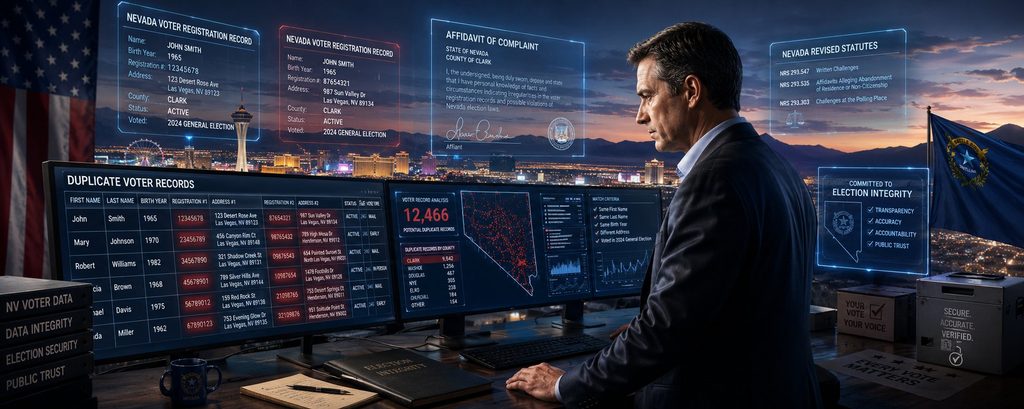
In January, I ran the kind of straightforward data analysis I’ve done professionally for decades on Nevada’s own public voter file: I looked for duplicate records. What I found in Clark County alone was 12,465 matched pairs of voter registrations sharing the same name and birth year, each pair tied to two different registration numbers and two different addresses. Of those, 12,283 pairs — 98.5% — show both registrations as currently Active in the Secretary of State’s own data, and every one of the 12,465 pairs reflects a recorded vote under both registration numbers in the 2024 General Election.
A few of these pairs likely trace back to the same person holding more than two active registrations at once, which is its own version of the same problem — a handful of individuals contributing several matched pairs apiece rather than 12,465 separate people. Either way, the number that matters isn’t the headline count. It’s this: nobody at the state has checked which pairs are duplicate administrative records, which are coincidental namesakes, and which are something that needs closer review. That’s the job.
I want to be precise about what that is and isn’t. It isn’t an accusation against any voter. I don’t know, and I’m not claiming to know, why any individual pair looks the way it does — a move, a name change, an administrative error, or something that needs a closer look. What it is, is exactly the kind of pattern a voter registration system is supposed to catch and resolve on its own, as a matter of routine.
I Followed the Process
On May 20, I filed a sworn affidavit laying out these findings with both the Clark County District Attorney and the Secretary of State’s Elections Division, and asked for an audit. The SOS assigned it a case number, C26-69 SOS, and told me an investigator would look into it.
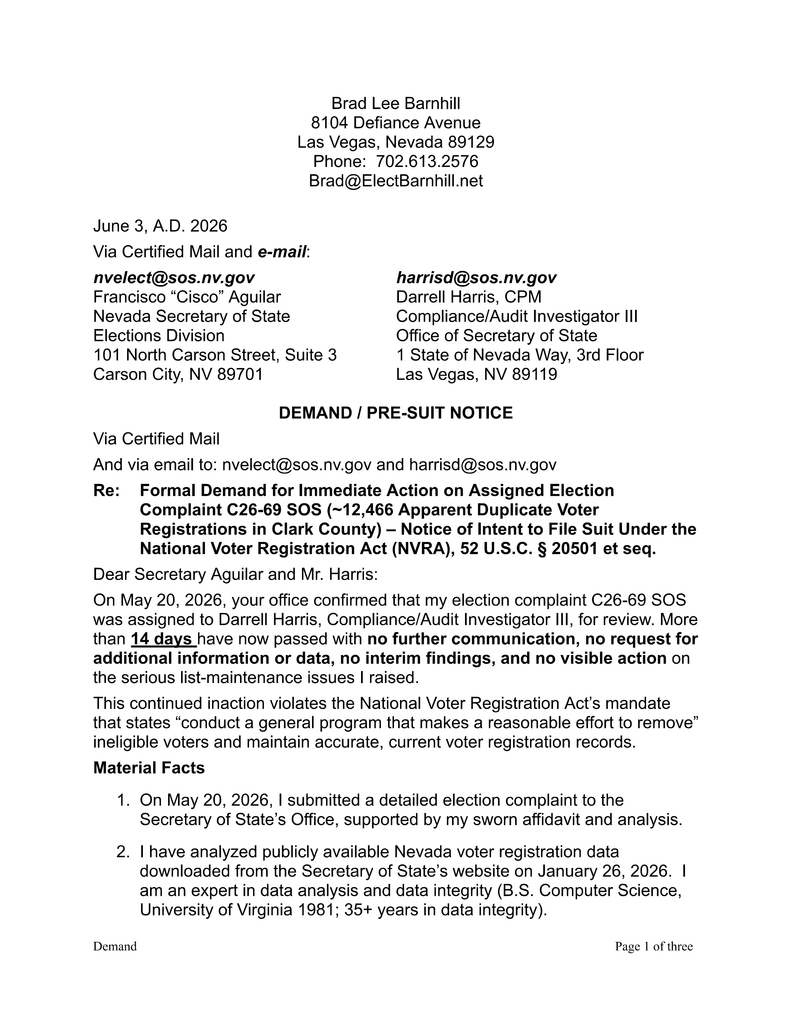
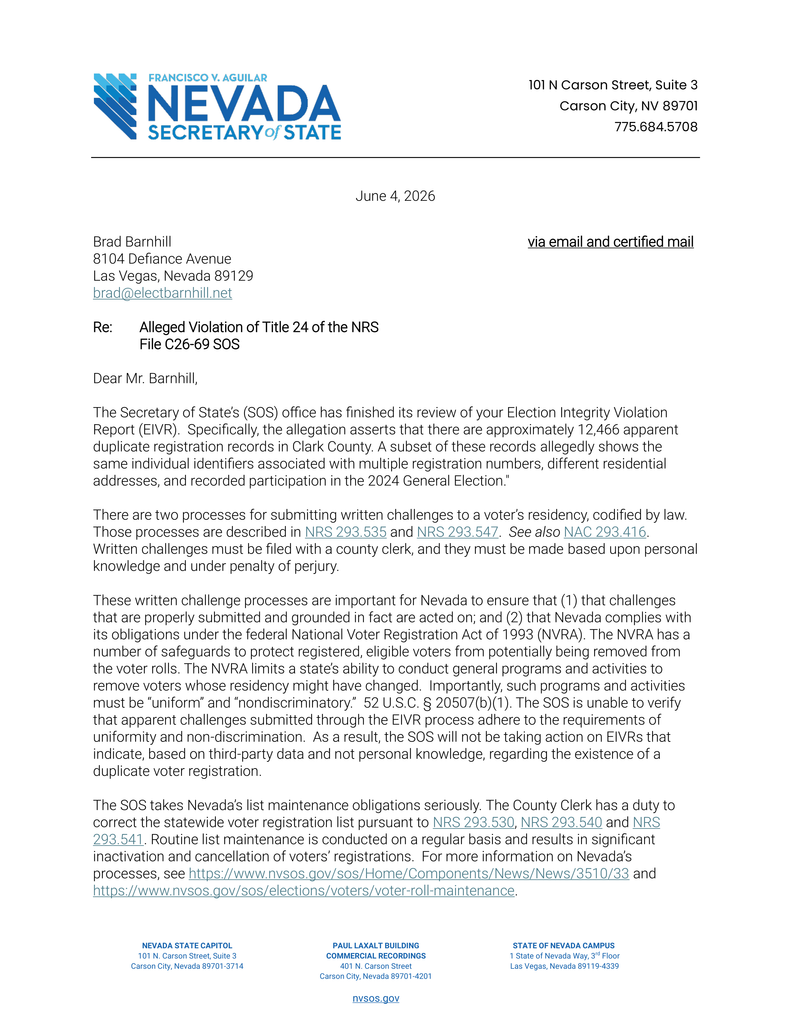
Then nothing happened. Two weeks of silence became three. On June 3, I sent a formal written demand invoking the federal law that governs exactly this situation — the National Voter Registration Act — and gave the office fourteen days to act.
On June 4, the Secretary of State’s office closed the file. Their letter didn’t dispute a single number in my analysis. Instead, it said my findings came from “third-party data” rather than personal knowledge of an individual voter, and pointed me toward the individual, name-by-name challenge process county clerks use — a process built for one voter at a time, not for a statewide data pattern of this size.
When the Law Says “Wait,” You Wait
Here’s the part I want to be straightforward with you about, because you deserve straight answers even when they’re inconvenient for a campaign timeline: federal law doesn’t let me sue the moment an agency says no. The National Voter Registration Act requires a 90-day waiting period between formal written notice and a lawsuit, specifically so the state gets a real chance to fix the problem instead of getting hauled into court on day one.
I gave Nevada that chance. That window has now closed. The Secretary of State’s office still hasn’t audited a single one of the flagged pairs.
So the complaint is drafted, reviewed, and dated. On September 4, 2026, I filed it in the U.S. District Court for the District of Nevada.
Update: That filing has now happened. On September 4, 2026, I filed Barnhill v. Aguilar in federal court. Read what the complaint asks the court to do and how this case reached federal court.
What Happens Next
This isn’t about proving fraud — I’ve never claimed that, and the lawsuit doesn’t either. It’s about making Nevada’s chief election officer do the job the law already requires: run a reasonable, good-faith program to keep the voter rolls accurate. The complaint asks the court to order exactly that — an audit of the flagged pairs, coordination with Clark County, and a documented process for catching this going forward.
Whether you’re a Democrat, a Republican, or you don’t belong to a party at all, the accuracy of the rolls affects the weight of your vote. That shouldn’t be a partisan question, and it shouldn’t require a lawsuit to get a straight answer. But if that’s what it takes, that’s what I’ll do.
I’ve spent twenty years untangling complicated cases as a litigation paralegal, and twenty years before that solving data problems as a systems analyst. This is what that background is for. Results, not noise.
Follow the case: After the filing, the next procedural milestone was service on the Secretary of State and the Nevada Attorney General. See what happened after service and what comes next in Barnhill v. Aguilar.
— Brad Lee Barnhill
#YourIndependentVoice for Nevada Secretary of State
Barnhill v. Aguilar — Case Timeline
May 20, 2026 Barnhill submitted a sworn complaint concerning alleged duplicate voter-registration records to the Nevada Secretary of State’s Elections Division and Clark County officials. See Who Will Protect Your Vote?
June 3–4, 2026 Formal notice was sent under the National Voter Registration Act. The Secretary of State’s office closed its file on June 4 without, according to the complaint, disputing the underlying data analysis.
September 4, 2026 Barnhill filed Barnhill v. Aguilar, Case No. 2:26-cv-02818-JAD-MDC, in the U.S. District Court for the District of Nevada.
September 8, 2026 Secretary of State Francisco V. Aguilar and the Nevada Attorney General’s office were formally served with the lawsuit.
September 16, 2026 Barnhill filed an ex parte motion asking the Court to authorize him to register as a CM/ECF filing user and receive electronic service in this action under LR IC 2-1(b), since the standard registration process assumes an attorney applicant. See A Small Procedural Fight, With a Bigger Point Behind It.
September 28, 2026 Secretary of State Aguilar moved the Court to stay Barnhill’s case indefinitely until a separate lawsuit brought by the Republican National Committee is resolved. Barnhill opposed the stay and asked the Court to consolidate or coordinate the two cases instead. See While the Secretary of State Asks for More Time, I’m Asking the Court to Move Faster.
September 28, 2026 Barnhill’s Certificate of Interested Parties, dated September 28, certified that the only parties to the case are Barnhill, a Nevada voter, and the Secretary of State, with no corporate backers, affiliates, or insurer. See The Court Asked Who Has a Stake in My Lawsuit. The Honest Answer Is You.
October 1, 2026 Barnhill’s Opposition to the motions to stay and extend time (ECF No. 9), Motion to Consolidate (ECF No. 10), and Notice of Related Cases (ECF No. 11) were filed by mail. They were not entered on the docket until October 5. The Court has not yet ruled on the September 16 e-filing motion. See Equal Access to the Courthouse Shouldn’t Depend on Having a Lawyer.
October 6, 2026 Barnhill mailed a Notice of Lodging Proposed Order and Request for Ruling on the September 16 e-filing motion, with a proposed order attached. See I’ve Asked the Court to Rule on My E-Filing Request.
Latest update: The Court Asked Who Has a Stake in My Lawsuit. The Honest Answer Is You.
I took the Secretary of State to federal court to protect your vote. Has your candidate?
8 thoughts on “Who Will Protect Your Vote?”