
Who will protect your vote? On September 25, 2026, the U.S. Supreme Court ruled 6-3 in DHS v. League of Women Voters (No. 26A308) that states may use the federal SAVE database to help verify voter citizenship, lifting a lower-court block on the program while the underlying legal fight continues into next year.
What the Court Actually Decided
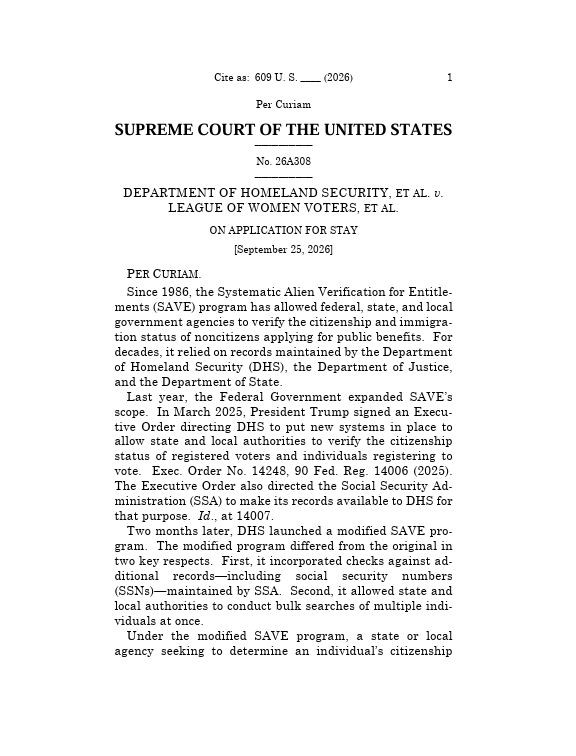
Per curiam opinion, DHS v. League of Women Voters, No. 26A308 (Sept. 25, 2026)
The Systematic Alien Verification for Entitlements (SAVE) program has run since 1986, helping federal, state, and local agencies verify citizenship and immigration status for benefits eligibility. Last year, an Executive Order directed the Department of Homeland Security to expand SAVE so state and local election officials could use it to check voter registrations, adding Social Security Administration records and the ability to run bulk searches instead of one voter at a time.
A federal district court blocked the expanded program, finding it was rushed and inaccurate. The Supreme Court’s per curiam order puts that block on hold, allowing states to use the tool voluntarily — but the Court did not rule on whether the expanded database is lawful. That question goes to a full hearing next year, after this November’s election.
Use of SAVE remains optional for states, and federal law already prohibits mass voter roll purges within 90 days of an election — a real limit on how much this ruling can change before November.
Nevada Is Already Living This Story
This isn’t a hypothetical for Nevada. Earlier this year, DHS told our Secretary of State’s office that a preliminary review had flagged as many as 15,903 potentially non-citizen registrations on Nevada’s voter rolls. The current administration pushed back, formally asking DHS to explain its methodology — a fair question, since courts have already found the underlying database prone to false positives.
Nevada voters are also weighing in directly: Question 7, the voter ID constitutional amendment, is back on the ballot this November for its required second vote after passing with roughly 73% support in 2024.
Put simply: Nevada is already at the center of the national debate over how to verify who’s on our voter rolls — without a clear, trusted process in place at the Secretary of State’s office.
The Right Way to Verify Voter Rolls
I don’t think Nevadans have to choose between election integrity and protecting eligible voters. Done right, they’re the same goal. That means:
- Flag and investigate, never automatically purge. Any tool used to check citizenship should trigger a review and a chance for the voter to confirm eligibility — not an automatic removal. (Here’s my full plan for cleaning up Nevada’s voter rolls.)
- Verify the verifier. Before Nevada relies on any federal database, the Secretary of State’s office should be able to show Nevadans its error rate and how disputes get resolved.
- Use existing authority, not new laws. The Secretary of State already has the regulatory and training authority to build a defensible, transparent verification process — this doesn’t require waiting on the Legislature. (See my full policy platform.)
- Publish the results. Whatever Nevada does here should be public, auditable, and repeatable — not a one-time political flashpoint.
What Happens Next
The Supreme Court left the core legal question open until after this election, and use of SAVE is voluntary — which means Nevada’s next Secretary of State will decide how, or whether, to use it going forward. That decision deserves more transparency than a preliminary DHS estimate and a records request has produced so far.
Nevadans deserve a Secretary of State who will build that process in the open, get it right, and let the results speak for themselves.
In the meantime, it’s worth double-checking your own status: here’s how to check your Nevada voter registration.
Results, Not Noise.
