

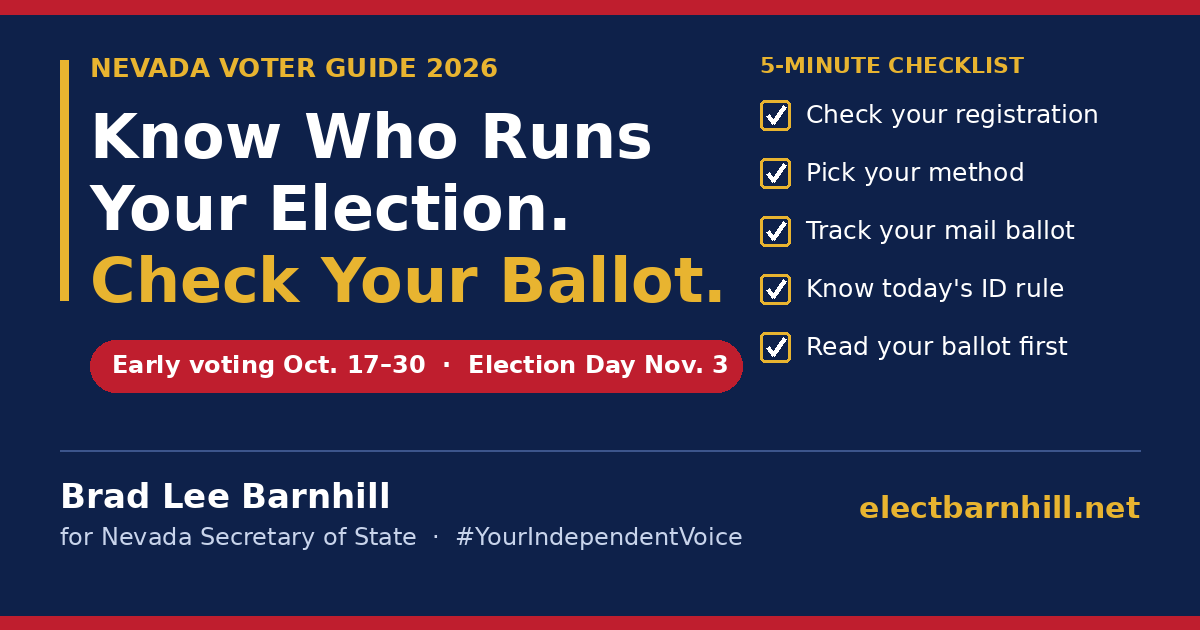
Early voting in Nevada’s general election runs from Saturday, October 17, through Friday, October 30, and Election Day is Tuesday, November 3. You shouldn’t need a law degree, a party connection, or a late-night argument online to know whether your ballot was handled correctly.
This guide covers five things: who actually runs your election, a five-minute checklist before you vote, what to do if something looks wrong, five questions to ask any candidate for Secretary of State, and how I answer them. The first three work no matter whom you vote for.
1. Who runs what
Your county election office runs the election you actually see: voting sites, mail ballots, signature checks, and counting. The Secretary of State’s office sets statewide rules and guidance, runs the statewide voter registration system, supports county training, and publishes statewide results.
That split matters. If something is wrong with your ballot, your county election office is usually the fastest fix. If the rules are unclear, or applied differently in Clark County than in Elko, that’s the Secretary of State’s job. Different local logistics are reasonable. Different standards for protecting a ballot are not.
2. A five-minute checklist before you vote
- Check your registration. Make sure your name and address are current. (Here’s how.)
- Pick your method. Every active registered voter is mailed a ballot. You can mail it, use a drop box, vote early in person, or vote on Election Day. If you mail it, officials suggest sending it about a week early.
- Track your mail ballot. Confirm it was received and counted. (Step-by-step guide.)
- Know today’s ID rule. Most voters don’t show photo ID under current law. If you register or update your registration in person during early voting or on Election Day, bring a Nevada driver’s license, DMV ID card, or tribal ID. Question 7 would change the rules if it passes again on November 3. (My implementation plan.)
- Registering now? You can still register online, but if you register after October 20 you won’t be mailed a ballot and will need to vote in person.
- Read your ballot first. Poll workers can’t explain candidates or ballot questions, so review your sample ballot at home.
3. If something looks wrong
If your ballot doesn’t arrive, your tracking status stalls, or you get a notice about your signature, contact your county election office right away. Signature problems can be fixed, but only before a deadline, so ask your county for the exact date and don’t wait. If you see a problem at a voting site, tell the site supervisor first and then your county election office. You can also contact the Secretary of State’s Elections Division.
Write down what happened, when, and whom you talked to. A clear record gets a faster answer than a social media post.
4. Five questions to ask any candidate for this office
- Can a lawful voter understand the process without a lawyer?
- Is there a reliable record of what happened to every ballot?
- Can the public see the rules before voting starts?
- Are safeguards applied the same way in every county?
- When a problem is found, is it fixed promptly and explained honestly?
5. How I answer them
- One rules page per election, the same in every county, published before anyone votes. (Showing the work.)
- A paper record behind every vote, audits you can actually read, and quarterly public reports. (Public Trust Starts With Elections Done Right.)
- Backup plans tested before every election, so a county knows how it will keep serving voters if a system goes offline, and smaller counties get the same support as Clark and Washoe. (Cybersecurity plan.)
- Voter education where voters already are: libraries, senior centers, veterans’ and faith groups, and in formats that work for voters with disabilities or limited internet access.
- Answers without a lawsuit: records requests within five business days and every closed complaint explained in writing. (The standard I’ll hold my office to.)
I’ve already practiced that last one. When I found 9,607 Nevadans with duplicate active voter registrations, I didn’t shout fraud. I asked for an audit, and when the office closed my complaint without disputing the data, I took it to federal court. Results, not noise.
The short version
- Dates: early voting October 17–30; Election Day November 3.
- Who to call: your county runs your ballot; the Secretary of State sets the rules for every county.
- Before you vote: check your registration, pick your method, track your ballot, and read it at home first.
- If something’s wrong: call your county right away, ask for the deadline, and write it all down.
- Before you choose: ask every candidate for this office the five questions above.
Nevada doesn’t need louder election arguments. It needs dependable records, trained people, secure systems, and rules you can see working. Make your plan, check your ballot, and vote.
I’ve put my plans in writing and taken the fight for clean voter rolls to federal court. Is your candidate for Nevada Secretary of State fighting this hard to protect your vote? If not, it’s time to take a closer look.
Get to know me · Join the campaign · Donate · See all policy positions
I’m not asking you to trust a party on any of this. I’m asking you to hold the office accountable for solving real problems. That’s the job, and I intend to do it.
— Brad Lee Barnhill
Independent American Party of Nevada Candidate for Nevada Secretary of State
#YourIndependentVoice — Results, Not Noise
