
Public trust in an election shouldn’t depend on which county you live in, which candidate you supported, or how closely you follow election policy. It should come from something simpler: clear rules, fair treatment for every lawful voter, careful ballot handling, and a process the public can see.
That kind of trust isn’t built with slogans. It’s built through administration, and administration is the Secretary of State’s job. I can’t make every Nevadan agree on every outcome. I can make sure every election runs on consistent standards, documented procedures, secure systems, and plain answers.
I’ve already started. When my analysis found 9,607 Nevadans with duplicate active voter registrations, I took it to the Secretary of State’s office. When the office closed my complaint without disputing the data, I took it to federal court. I’m not alleging fraud. I’m asking for an audit and a public accounting, because that’s how trust gets earned.
Here’s what elections done right look like, piece by piece.
Trust is earned before Election Day
An election doesn’t start when ballots go out. It starts with accurate registration records, trained election workers, tested equipment, and secure data systems. When those basics slip, doubt grows. When they’re handled well and explained openly, voters have a reason to be confident.
That starts with the voter rolls. My approach is flag and investigate: records get flagged by matching data, and then people check them. No lawful voter gets removed automatically, and a voter who moves or changes a name should get a timely, understandable answer. (See the full voter roll maintenance standard.)
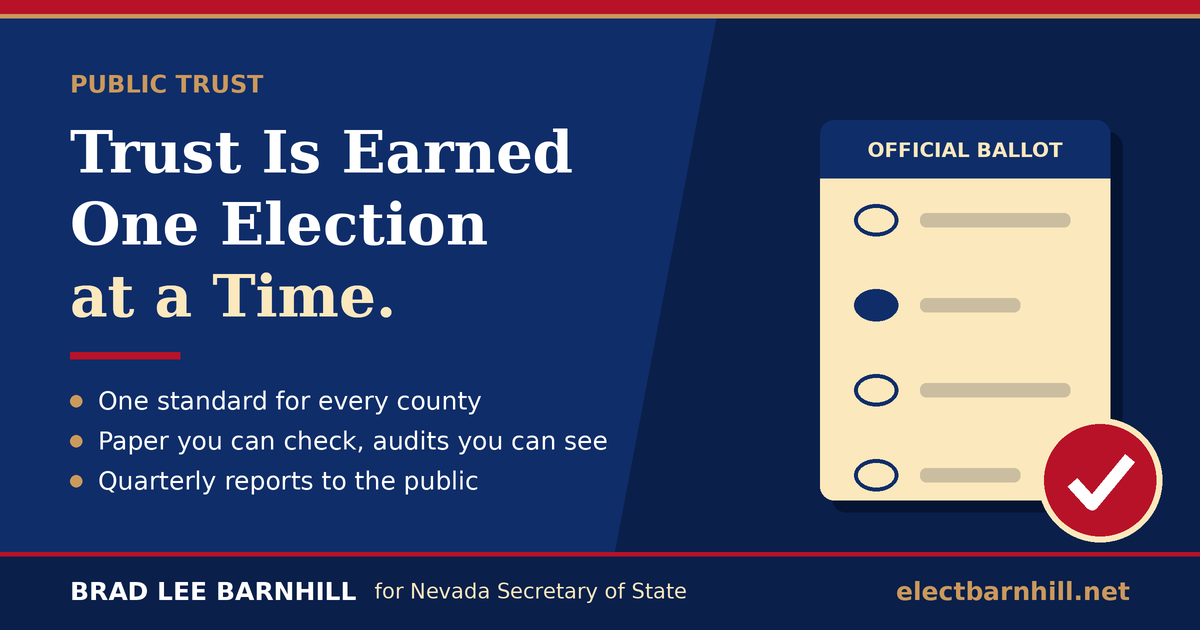
One standard for every county
Clark County and a small rural county face very different challenges. Still, every Nevadan deserves the same core protections: secure registration, reliable ballot handling, verified counting, and equal respect under the law. The standard stays the same everywhere; what changes is the support. A small rural office may need technical help, shared training, or more time to adopt a new system, and the state should plan for that from the start. (More on consistent county standards and rural voting access.)
Security and access belong together
A well-run system protects every lawful ballot and gives every lawful voter a practical way to take part. Voter ID is the test case. If Question 7 passes again this November, the rollout has to reach seniors, students, rural residents, and voters with disabilities well before anyone shows up to vote. Voters should know what ID is accepted, where to get help, and what to do if a question comes up. Confusion isn’t security. (Read my Voter ID implementation plan.)
Paper you can check, audits you can see
Technology should never leave the public with nothing to check. A paper record behind every ballot is what lets us prove the count was right. Election-night totals are an early public update; certification is the careful legal process that follows. Officials should explain that difference plainly every time.
Nevada law already requires audits before results are certified, and the Secretary of State’s office writes the rules for them. That means I can publish audit schedules and results in plain language without waiting on the Legislature. (See how Nevada election audits build voter confidence and election technology Nevada voters can actually check.)
Report to the public every quarter
Voters shouldn’t have to dig for answers after a rumor starts. As Secretary of State, I’ll publish quarterly plain-language reports on voter-roll maintenance, whether counties are meeting statewide requirements, cybersecurity preparedness, and readiness for the next election, with measurable benchmarks and a clear list of what’s left to do.
Some security details have to stay private so they can’t be misused. But the public can always be told what the standards are, who is responsible for them, and whether they were met. (More in my election cybersecurity plan.)
Calm leadership, measurable results
Democrats, Republicans, independents, and nonpartisan voters all have the same stake in elections that are secure, accessible, and worthy of confidence. I spent 20 years as a systems analyst and 20 years as a Nevada litigation paralegal, and both taught me that details matter. A policy is only as good as the procedure behind it, the training that supports it, and the public record that shows whether it worked.
Public trust isn’t restored by telling citizens to stop asking questions. It’s strengthened when government answers them with clear rules, honest records, and careful audits, one well-run election at a time.
I’ve also written down the standard I’m asking you to hold my own office to: I’ll Hold My Office to the Same Standard I Held Theirs.
I’ve put my plans in writing and taken the fight for clean voter rolls to federal court. Is your candidate for Nevada Secretary of State fighting this hard to protect your vote? If not, it’s time to take a closer look.
Get to know me · Join the campaign · Donate · See all policy positions
I’m not asking you to trust a party on any of this. I’m asking you to hold the office accountable for solving real problems. That’s the job, and I intend to do it.
— Brad Lee Barnhill
Independent American Party of Nevada Candidate for Nevada Secretary of State
#YourIndependentVoice — Results, Not Noise
2 thoughts on “Public Trust Starts With Elections Done Right”