


Today, November 23, 2026, I am filing my opposition to the Nevada Secretary of State’s motion to dismiss my lawsuit under the National Voter Registration Act (NVRA). The case is Barnhill v. Aguilar, No. 2:26-cv-02818-JAD-MDC, in the U.S. District Court for the District of Nevada. I am appearing in propria persona, as myself. Below I explain what the case is about, what the Secretary argued, how I responded, and where I think the motion falls short. The court has not ruled, and everything here is my own view as the plaintiff.
Read the filings: Complaint (ECF 2) · Secretary’s Motion to Dismiss (ECF 20) · Order Denying Stay (ECF 17) · My Opposition (link will be added once filed). See also my earlier post, The Secretary of State Says He Doesn’t Have to Look.
What the case is about
In January 2026 I downloaded Nevada’s voter registration data from the Secretary of State’s public data portal and analyzed the Clark County file. Matching on first name, last name, and birth year, I found 9,607 people who each appear on the active rolls under two or more registration numbers at different residential addresses, for a total of 12,465 matched registration pairs. Most (8,614) had two registrations, but 795 had three, and a handful had as many as seven or eight. In every matched pair, the data shows a vote recorded in the 2024 General Election under both registration numbers.
On May 20, 2026, I sent those findings to the Secretary’s Elections Division in a sworn affidavit and asked for a review, audit, and reconciliation of the affected records. The office opened a file and assigned an investigator. On June 3 I sent formal notice under the NVRA. On June 4 the office closed the file. Its letter said the office “will not be taking action on EIVRs that indicate, based on third-party data and not personal knowledge, regarding the existence of a duplicate voter registration,” and pointed me to Nevada’s individual voter-challenge statutes.
To be fair to the Secretary, the letter also gave a reason: the NVRA requires list-maintenance programs to be “uniform” and “nondiscriminatory,” and the office said it could not verify that reports submitted through its complaint process meet that standard. The letter also stated that routine list maintenance is conducted regularly. What the letter did not do was dispute my numbers, describe any check of the flagged records, or mention any coordination with the Clark County Clerk about them.
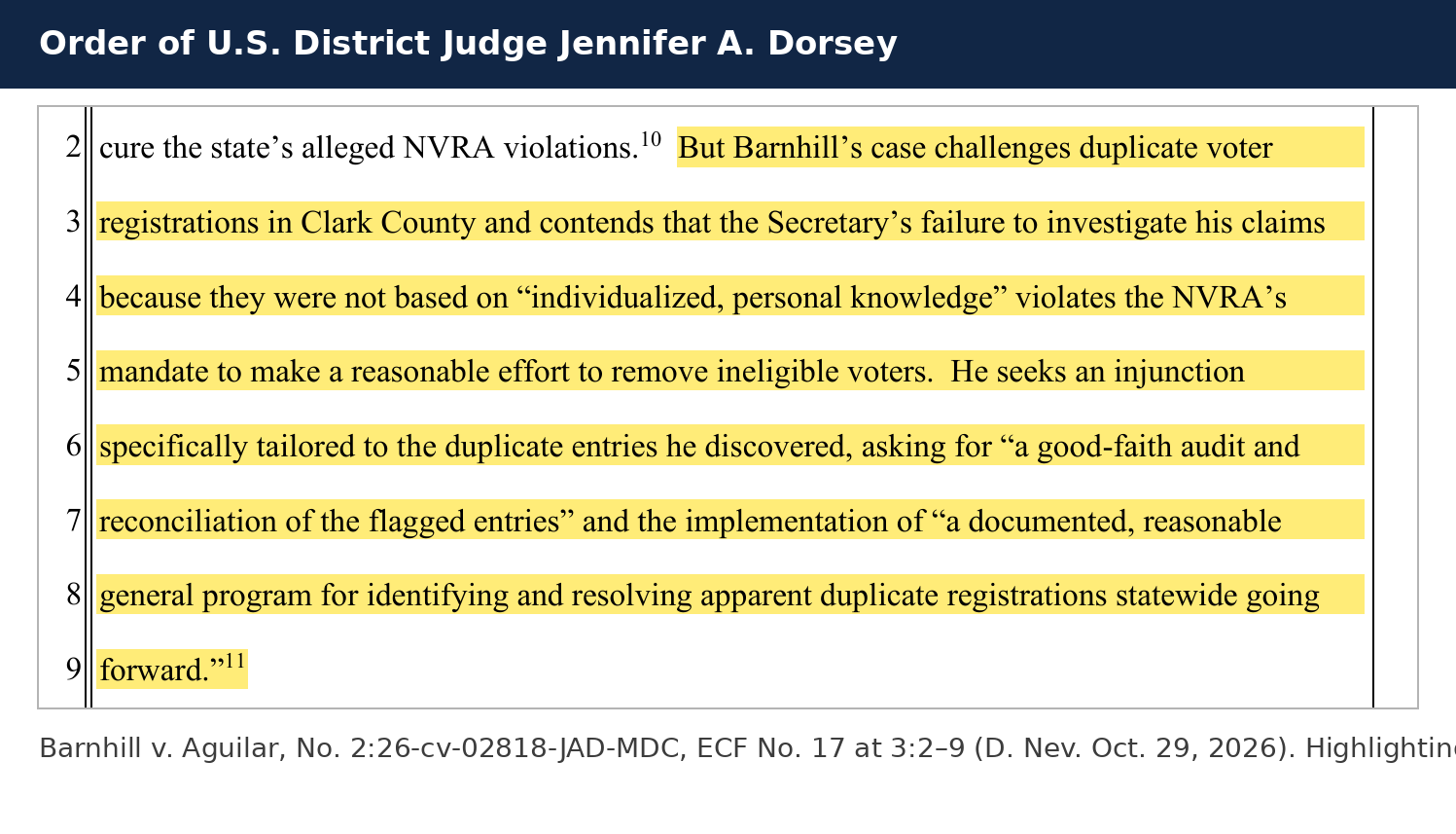
I filed my complaint in September. In an order denying the Secretary’s request for a stay, Judge Dorsey described my claim as whether the Secretary’s refusal to act on my findings because they were not based on “individualized, personal knowledge” violates the NVRA’s requirement that states make a reasonable effort to remove ineligible voters (ECF 17).
What the Secretary argues
The motion to dismiss, filed November 19, makes three main arguments:
- No duty to investigate. The NVRA does not require election officials to investigate every allegation a private citizen submits, and “a request for investigation is not a statutory right.”
- No facts about Nevada’s program. The complaint says “virtually nothing” about how Nevada actually maintains its rolls, so it cannot plausibly show the program is unreasonable.
- No ineligible voters identified. I did not allege that any specific voter is ineligible, and I expressly disclaimed any accusation of wrongdoing.
How I responded
This case is about the State’s program, not a personal right to an investigation. I agree that the NVRA does not give every citizen the right to demand an investigation. That is not my claim. Section 8 requires the State to “conduct a general program that makes a reasonable effort” to remove the names of voters who have died or moved. My claim is that a program that, as a matter of stated policy, will not look at data-driven evidence of thousands of apparent duplicates, from any source, is not a reasonable effort. That is also how the court framed the question.
The challenge statutes can’t do this job. The Secretary pointed me to Nevada’s voter-challenge laws, NRS 293.535 and 293.547. As reproduced in the Secretary’s own exhibits, a challenge under NRS 293.547 can be filed only by a voter in the same precinct as the challenged voter, only on personal knowledge, only in a short window between the 30th and 25th day before an election, and it may name only one person. NRS 293.535’s residence ground covers only people who have moved out of the county, so it does not reach someone registered at two addresses inside Clark County. No one has personal knowledge of where thousands of strangers live. A tool built for one-at-a-time challenges between neighbors is not a substitute for the State’s own program.
Nevada already requires the check I’m asking about. Nevada’s own regulation says that on each business day the Secretary will check the statewide list to determine “whether any person is included as a registered voter in the statewide voter registration list more than once” (NAC 293.462(1)). The federal Help America Vote Act requires list maintenance that ensures “duplicate names are eliminated” from the statewide list. And the NVRA itself lets states match their rolls against outside data such as Postal Service change-of-address records. If the State can check its list against outside data, it is at least plausible that a reasonable program would check its list against itself. I am not bringing a separate HAVA claim; these laws are context for what a “reasonable effort” looks like.
The facts I pleaded are enough at this stage. At the motion-to-dismiss stage, the court must accept the complaint’s facts as true. I pleaded two kinds of facts: the outcome (thousands of apparent duplicates persisting in one county despite a required daily check) and the policy (the Secretary’s written refusal to look at data-based reports). The internal details of how the Secretary’s program runs are in the Secretary’s hands, not mine, and the law does not require a plaintiff to plead facts only the defendant has before discovery. The Secretary’s own statements in the June 4 letter, such as that routine maintenance happens regularly, can’t be taken as true on a motion to dismiss to contradict what the complaint alleges.
A duplicate at a different address is a change-of-residence issue. Section 8 specifically covers registrants who become ineligible “by reason of … a change in the residence of the registrant,” and it requires a registrar to correct the list when someone moves within the same jurisdiction. When the same person is actively registered at two addresses, at least some of those records plausibly reflect moves the State has not processed. My statement that I was not accusing anyone of wrongdoing was exactly that: most outdated registrations come from ordinary, innocent moves. Declining to accuse my neighbors of crimes is not a concession that the rolls are accurate.
I’m not asking anyone to be removed without protections. Any registration found to be outdated would still go through the NVRA’s notice-and-waiting procedures, and in-county moves are corrected rather than cancelled. Those safeguards are reasons to do list maintenance carefully, not reasons to skip it.
Finally, if the court finds anything missing from the complaint, I asked for leave to amend, which courts in the Ninth Circuit grant freely for a first complaint, especially when the party appears on their own behalf without an attorney.
Where the motion stumbles
Beyond the legal arguments, my opposition points out several places where the motion does not match the record or its own sources. None of these alone decides the motion, but they matter because the motion’s arguments rest on its own description of my case rather than on the complaint.
- It attributes the court’s words to my complaint. The motion quotes the court’s framing of the issue but cites it to my complaint (ECF 2), then argues the answer is obvious because there is no “right to an investigation.” The court framed the question under Section 8’s reasonable-effort standard.
- It gets the date of the Secretary’s own letter wrong. The motion says the office responded “on May 29, 2026.” The letter in the Secretary’s own exhibits is dated June 4, and the motion elsewhere calls it the “June 4 Secretary of State Closure Letter.”
- It relies on a citation that can’t be identified. One authority is cited only as “Judicial Watch, Inc., 524 F. Supp. 3d at 389–90,” with no case name, court, or full citation anywhere in the motion. The same quotation is attributed to a different case earlier in the brief. The most likely candidate begins at page 399, so a pin cite to pages 389–90 cannot refer to it. (The point it is cited for, that the NVRA requires a reasonable effort rather than a perfect one, is not in dispute.)
- It understates what I alleged. The motion describes my matches as records with different registration numbers “or” addresses. The complaint alleges both, plus 2024 votes recorded under both registration numbers.
- It misattributes quotes and pin cites. Phrases the motion attributes to my affidavit actually appear in my cover letter, and the motion cites Iqbal at page 678 for the phrase “obvious alternative explanation,” which appears at page 682.
Where the Secretary and I agree
The Secretary is right that the NVRA requires a reasonable effort, not perfect rolls, and right that the NVRA protects eligible voters from improper removal. I agree with both. My case does not depend on the rolls being perfect, and I am not asking the court to order any voter removed. The question is whether a program that refuses on principle to examine evidence like this is reasonable, and I believe that question should be decided on a real record, not dismissed at the outset.
What happens next
Under the court’s local rules, the Secretary may file a reply within 7 days. After that, the court will decide the motion, with or without a hearing. I will post updates as the case moves forward.
I am the plaintiff in this case and am appearing as myself. This post reflects my own views and my reading of the public filings. It is not legal advice, and the court has not ruled on any of these issues.
Barnhill v. Aguilar — Case Timeline
May 20, 2026 Barnhill submitted a sworn complaint concerning alleged duplicate voter-registration records to the Nevada Secretary of State’s Elections Division and Clark County officials. See Who Will Protect Your Vote?
June 3–4, 2026 Formal notice was sent under the National Voter Registration Act. The Secretary of State’s office closed its file on June 4 without, according to the complaint, disputing the underlying data analysis.
September 4, 2026 Barnhill filed Barnhill v. Aguilar, Case No. 2:26-cv-02818-JAD-MDC, in the U.S. District Court for the District of Nevada.
September 8, 2026 Secretary of State Francisco V. Aguilar and the Nevada Attorney General’s office were formally served with the lawsuit.
September 16, 2026 Barnhill filed an ex parte motion asking the Court to authorize him to register as a CM/ECF filing user and receive electronic service in this action under LR IC 2-1(b), since the standard registration process assumes an attorney applicant. See A Small Procedural Fight, With a Bigger Point Behind It.
September 28, 2026 Secretary of State Aguilar moved the Court to stay Barnhill’s case indefinitely until a separate lawsuit brought by the Republican National Committee is resolved. Barnhill opposed the stay and asked the Court to consolidate or coordinate the two cases instead. See While the Secretary of State Asks for More Time, I’m Asking the Court to Move Faster.
September 28, 2026 Barnhill’s Certificate of Interested Parties, dated September 28, certified that the only parties to the case are Barnhill, a Nevada voter, and the Secretary of State, with no corporate backers, affiliates, or insurer. See The Court Asked Who Has a Stake in My Lawsuit. The Honest Answer Is You.
October 1, 2026 Barnhill’s Opposition to the motions to stay and extend time (ECF No. 9), Motion to Consolidate (ECF No. 10), and Notice of Related Cases (ECF No. 11) were filed by mail. They were not entered on the docket until October 5. The Court has not yet ruled on the September 16 e-filing motion. See Equal Access to the Courthouse Shouldn’t Depend on Having a Lawyer.
October 6, 2026 Barnhill mailed a Notice of Lodging Proposed Order and Request for Ruling on the September 16 e-filing motion, with a proposed order attached. See I’ve Asked the Court to Rule on My E-Filing Request.
October 16, 2026 The Court denied the October 6 request for ruling as moot and set October 23 as the deadline for responses to Barnhill’s e-filing motion (ECF No. 14).
October 23, 2026 The response deadline on Barnhill’s e-filing motion passed with no opposition from the Secretary of State.
October 27, 2026 Two notices Barnhill mailed on October 19 were docketed (ECF Nos. 15 and 16). One notified the Court that the Secretary had not opposed the motion to consolidate, withdrew the consolidation request, and asked only for coordination of pretrial proceedings. See the notice.
October 29, 2026 Judge Jennifer A. Dorsey denied the Secretary’s motion to stay, denied the motion to consolidate, and gave the Secretary until November 19 to answer the complaint (ECF No. 17). See The Secretary of State Asked the Court to Park My Case. The Judge Said No.
October 29, 2026 Magistrate Judge Maximiliano D. Couvillier III granted Barnhill’s unopposed motion to register as a CM/ECF filer and receive electronic service (ECF No. 18). The order arrived by mail on November 4. See It Took 43 Days to Get Permission to File Like a Lawyer. The Order Came by Mail.
November 5, 2026 Barnhill filed his first document through CM/ECF, a Certificate of Compliance with the e-filing order (ECF No. 19), attaching his PACER e-filing status for the District of Nevada showing “Active.” It reached the docket the same day. See The Order Came by Mail. My Next Filing Didn’t.
November 19, 2026 Instead of answering the complaint, the Secretary of State moved to dismiss it (ECF No. 20), with an appendix of exhibits that includes Barnhill’s May 20 complaint to the Elections Division and the Secretary’s June 4 closure letter (ECF No. 21). Barnhill’s response is due December 3. See The Secretary of State Says He Doesn’t Have to Look.
November 23, 2026 Barnhill files his opposition to the Secretary’s motion to dismiss, arguing that the complaint challenges the reasonableness of the State’s list-maintenance program, not a personal right to an investigation, and pointing out where the motion does not match the record. See Why Nevada’s Motion to Dismiss Misses the Point: My Response in Barnhill v. Aguilar.
Latest update: Why Nevada’s Motion to Dismiss Misses the Point: My Response in Barnhill v. Aguilar
The election is over. This case isn’t.
