
Most Nevadans registered to vote the same way: at the DMV, half-listening, while they waited for a new license photo. Over the last 30 years, what happens at that counter has changed three times. Today you’re registered automatically, labeled automatically, and checked by a citizenship box you initialed on your way out the door.
I spent 20 years as a computer systems analyst. When a system changes its defaults, I want to know what the new defaults produce. Here’s what Nevada’s did, and the check that’s still missing.
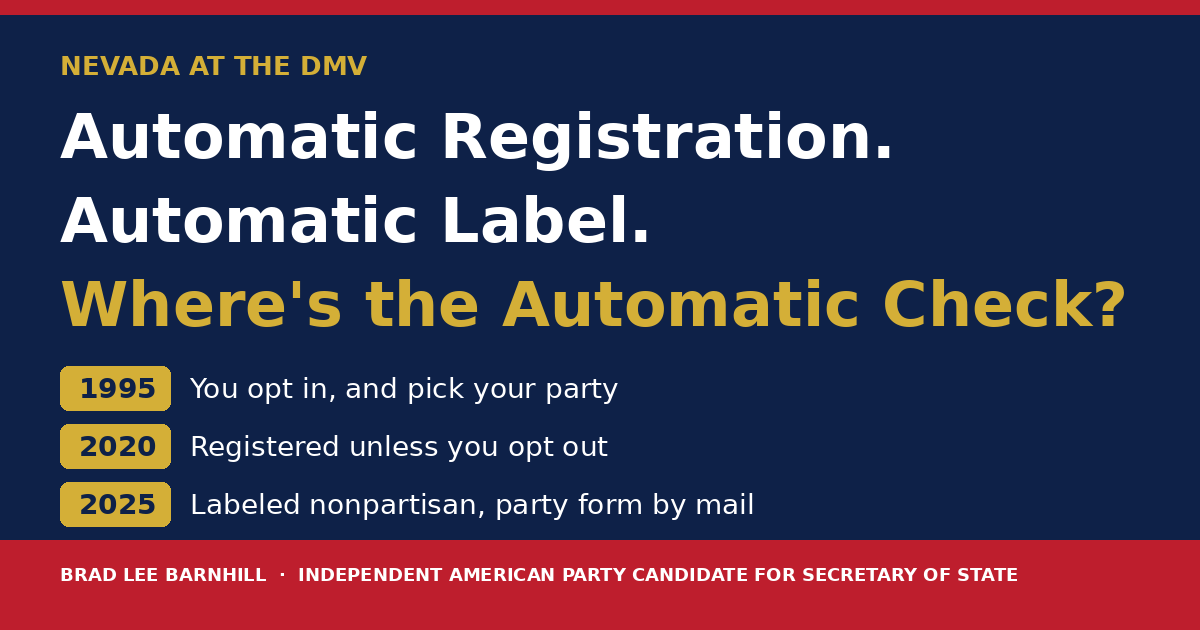
Three systems in 30 years
- 1995: You opt in. The federal “motor voter” law took effect in Nevada on January 1, 1995. The DMV offered you a registration form, and you chose whether to fill it out and which party to join.
- 2014: A separate card for drivers without lawful status. The 2013 Legislature created the Driver Authorization Card for residents who can’t prove citizenship or lawful presence. It’s a permit to drive, not an ID, and its holders are excluded from DMV voter registration.
- 2020: You’re registered unless you opt out. Governor Sandoval vetoed automatic registration in 2017, warning it took the choice away from voters and could sweep in ineligible people. Voters approved it anyway as Question 5 in 2018. Starting in January 2020, everyone getting a license or ID was registered unless they declined, and could still pick a party at the counter. Nonpartisan was the default.
- 2025: You’re registered as nonpartisan, then mailed a form. A 2021 bill (AB 432) added Medicaid and the health insurance exchange as registration agencies and quietly took party selection away from the DMV counter. A 2023 bill delayed it to 2025. Now your county mails you a party form after your eligibility is confirmed. If you don’t send it back, you stay nonpartisan.
What the defaults did to the rolls
Nonpartisans became Nevada’s largest group of voters in 2023. In 2025, 94% of new registrants in Clark County and 88% in Washoe were nonpartisan. As of September 2026, 38.85% of active voters are nonpartisan, compared with 27.61% Democrats and 27.40% Republicans.
The rolls also carry 416,618 inactive registrations, and 46% of those are nonpartisan. Automatic registration adds people who never meant to vote, and every one of them is a record someone has to keep accurate. That’s part of why I’ve pushed for careful, lawful voter-roll maintenance.
The label nobody asked you about
I’ve said you’re not undecided, you’re unrepresented, and I stand by it. Many Nevadans chose to be independent. But since 2025, many more were labeled nonpartisan because a form never came back. Some of them don’t know that, under Nevada’s closed primaries, the label keeps them out of the June primary.
Voters deserve to know what label the state gave them, what it means, and how to change it. (Check your registration here.)
How a noncitizen ends up on the rolls
Only citizens may vote. Nevada screens noncitizens out of automatic registration in two ways: a citizenship question on the DMV form, and a rule that anyone who shows immigration documents, like a green card, isn’t sent into the voter registration process. Driver Authorization Card holders are excluded entirely.
That screen catches a lot. Here’s where it can miss:
- Lawful noncitizens get standard licenses. Green-card and visa holders aren’t on a separate card. If a technician mis-keys one answer, they can be registered. In 2021, a Canadian resident alien in Clark County received a voter card after a license renewal. The DMV said a technician entered her “no” as “yes.”
- A false “yes.” Someone who never shows immigration documents and checks “citizen” isn’t stopped by the document rule. Election officials then match name, birth date, and Social Security data, which confirms identity, not citizenship. Lying on that box is a felony, and that’s the main deterrent.
- No one checks against a citizenship source. Nevada has declined to use the federal SAVE system to check its rolls.
How big is the problem? In 2017, under the old opt-in system, the Secretary of State found about 100 DMV customers who had shown noncitizen documents and filled out a registration form. Twenty-one had voted, and the office said it had evidence that three noncitizens registered and voted in Clark County. That’s small, and I won’t pretend it’s bigger. But it was found only because someone looked, and no one has published a count since automatic registration began.
I’m not alleging fraud. I’m asking the office to measure it, the same way I’ve asked it to account for 9,607 duplicate registrations.
What I’ll do without waiting on the Legislature
- Use individualized SAVE checks, carefully. Check records with a specific reason for review, like immigration documents on file at the DMV. Confirm any flag with a second source, give the voter written notice and a chance to respond, and follow federal rules, including no systematic removals in the 90 days before a federal election.
- Reconcile DMV and voter records every year. Compare registrations that came through the DMV with DMV records showing immigration documents, and fix what’s wrong.
- Treat DMV errors as the state’s mistake. A noncitizen registered by a technician’s error should be removed quietly and told plainly that the error wasn’t theirs, so no one is afraid to report it.
- Publish the numbers. My quarterly public reports will include automatic registrations by agency, how many were screened out, errors found and corrected, and how many party forms were returned.
- Make the party form impossible to miss. Plain language, a clear note that nonpartisan voters can’t vote in partisan primaries, and the same form in every county.
I’ll also draft a bill draft request to let voters pick a party at the DMV once their eligibility is confirmed, so a label is a choice, not a default.
The short version
Nevada moved from asking voters to defaulting them: registered automatically, labeled automatically. The one thing that never became automatic is a check that the people on the rolls are eligible to be there. I’ll add it, carefully and lawfully, and show you the results.
Sources: 1995 Legislature minutes on NVRA; The Nevada Independent, Jan 2026; Nevada Independent fact brief; Nevada Independent, Apr 2017; KSNV, Oct 2026.
I’ve put my plans in writing and taken the fight for clean voter rolls to federal court. Is your candidate for Nevada Secretary of State fighting this hard to protect your vote? If not, it’s time to take a closer look.
Get to know me · Join the campaign · Donate · See all policy positions
I’m not asking you to trust a party on any of this. I’m asking you to hold the office accountable for solving real problems. That’s the job, and I intend to do it.
— Brad Lee Barnhill
Independent American Party of Nevada Candidate for Nevada Secretary of State
#YourIndependentVoice — Results, Not Noise
