

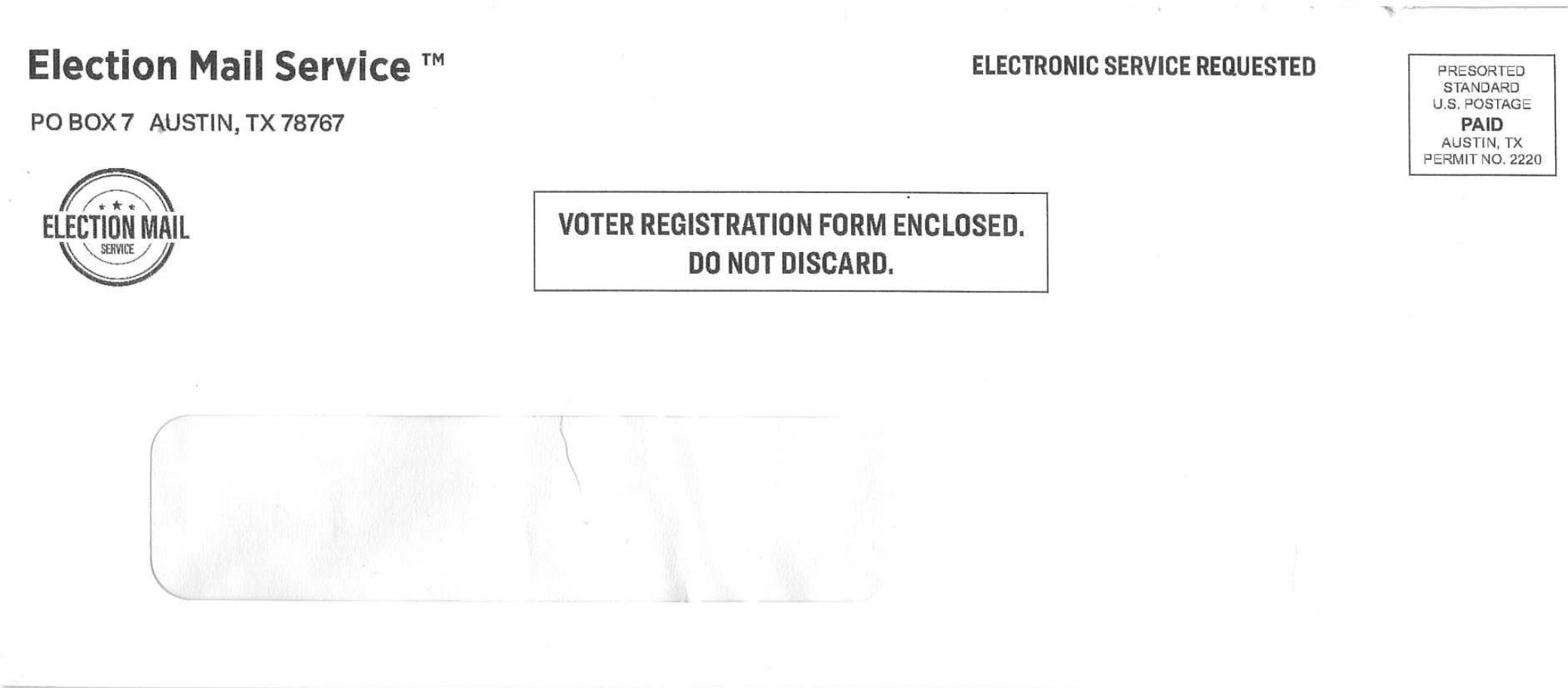
This fall, an envelope arrived at my house in Las Vegas. Across the front, in capital letters: “VOTER REGISTRATION FORM ENCLOSED. DO NOT DISCARD.”
It was addressed to someone who has never lived here. My wife bought this house new, when it was still the builder’s model home, and no one outside our household has ever lived at this address. The person named on the envelope lives in Florida and is registered to vote there. That person can’t lawfully register in Nevada.
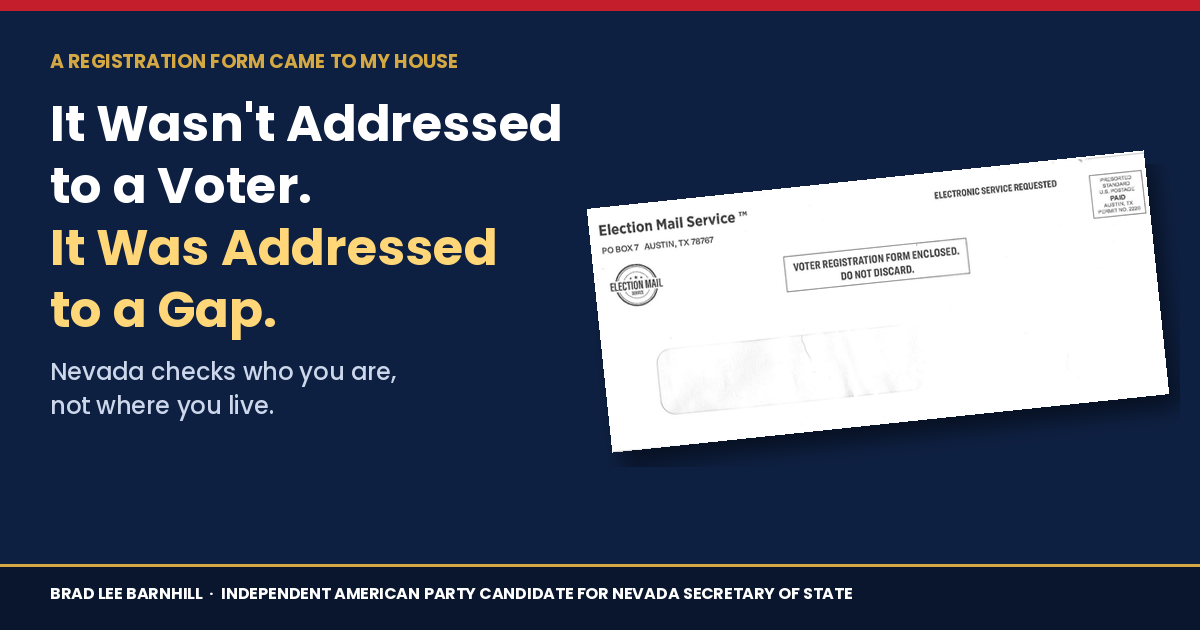
Inside was a flyer saying that “public records show” the recipient may not be registered at this address. It came with a registration form and a postage-paid envelope, plus a promise that the sender would follow up “within the next month to confirm your registration.”
Here’s what I’ll cover: who sent it, why a form at the wrong address is a real risk in Nevada, what I’ll do about it as Secretary of State without waiting on the Legislature, and the bill I’ll ask the Legislature to pass.
Who sent it
The return address reads “Election Mail Service,” a post office box in Austin, Texas. Election Mail Service is a project of Civitech, an Austin company. Civitech isn’t shy about its mission. Its website says it builds technology and data products to help Democratic candidates win and progressive causes succeed, and it says it helped its clients register more than 800,000 voters in 2020.
Civitech’s founder, Jeremy Smith, also runs a sister company, Civic Government Solutions, that sells voter-registration mailings to local governments. In 2024, Texas Attorney General Ken Paxton sued Bexar County over its contract with that company, arguing it sent tax-funded registration mail through a vendor with Democratic ties. Local Republicans objected that the program was designed to help one party. A judge declined to stop the mailing, and Smith said the county work was nonpartisan.
Partisan registration drives are legal, and campaigns on all sides run them. I’m not accusing Civitech of fraud. But voters should know what this is. It isn’t a public service from your county. It’s a political operation, run from Texas, that decides whose door gets a registration form based on data it buys. When that data is wrong, the form lands at the wrong door.
That has happened before. In 2020, Alabama’s Secretary of State warned voters about Election Mail Service forms and wrote that its list appeared to be based on outdated voter data. The same year, North Carolina officials reported that Civitech and its printer had mailed about 11,000 forms with the wrong names, addresses, and birth dates.
Why a wrong address is a real risk in Nevada
In most states, a bad registration is a bad line on a list. In Nevada, it’s a ballot in the mail.
Nevada mails a ballot to every active registered voter, every election. So if a form like this one were filled out and returned in the name on that envelope, the state wouldn’t just add a name to its rolls. It would mail a live ballot to an address where that person has never lived, and keep mailing one every election until someone noticed.
Four gaps make that hard to catch:
- Identity isn’t residency. The paper form accepts a Nevada license number or the last four digits of a Social Security number. The county checks that those belong to a real person. Nobody checks that the person lives at the address on the form.
- The signature on file is whoever signed the form. Mail ballots are verified by comparing the envelope signature to the signature on the registration. If someone other than the voter signed the registration, every later ballot from that same signer will match.
- Nevada can’t see Florida’s rolls. Nevada shares registration data with other states through ERIC, the Electronic Registration Information Center. Florida left ERIC in 2023, along with Texas, Missouri, and several other states. A person registered in both Florida and Nevada wouldn’t be routinely flagged.
- The paper form is the weakest way in. Online registration requires a Nevada driver’s license or state ID, which ties the record to the DMV. The paper form that a third party mails to your house doesn’t.
Filling out a registration form for someone else, or registering where you don’t live, is a felony in Nevada (NRS 293.800). The law is clear. But a law only deters people if the system can catch the ones who break it. Today, Nevada’s system is designed to confirm who you are, not where you live.
Scale makes this worse. Mailers like these go out by the hundreds of thousands. One Texas county contract with Civitech’s sister company called for 210,000 of them. At that volume, even a small error rate puts thousands of forms in the hands of people who can’t lawfully use them.
I’m not saying fraud is happening at any particular rate. I’m saying no one can tell you the rate, because no one is checking. That’s the same problem I took to federal court over 9,607 Nevadans with duplicate active registrations. The Secretary of State’s office closed my complaint without disputing the data, then asked the court to put my case on hold. I’m asking for an audit, not alleging fraud. You can’t fix what you won’t count.
What I’ll do without waiting on the Legislature
The Secretary of State’s office already has the authority to take these six steps:
- Share data with the states Nevada can’t see today. Some states have direct agreements with states outside ERIC; Georgia has them with Florida, Alabama, and Virginia. I’ll pursue the same with Florida, Texas, and the other states that left, so a registration in two states gets flagged before an election, not after. That’s part of how I’d clean up Nevada’s voter rolls.
- Replace the guidance that keeps credible reports off the table. In 2024, the current office told county clerks they generally can’t rely on outside information to correct the rolls. I’ll replace that memo. A sworn report from a homeowner saying “this person has never lived here” should start the notice process federal law requires. No one gets removed without notice and due process, but no credible report gets ignored. (More on doing voter-roll maintenance by the rules.)
- Give you a one-page way to report it. Nevada law already lets a registered voter challenge a registration with a sworn statement. Almost nobody knows that. I’ll publish a simple form and a plain-language guide.
- Help you tell official mail from everything else. The office’s “Official Election Mail” page will add what to do when registration mail arrives for someone who doesn’t live at your address.
- Name bad lists publicly. When a third-party mailer sends Nevadans forms based on bad data, my office will say so, by name, whatever party the sender works for.
- Count it, and check it. My quarterly public reports will include how many registrations were challenged as non-residents, how many were confirmed, and how many were referred for prosecution. Those numbers belong in the same post-election audits I’ve proposed, and in the plain-language transparency every county should publish.
That’s the approach I’ve laid out for what an independent Secretary of State can do with a Democrat-controlled Legislature: use the authority the office already has, and stop waiting.
The bill I’ll ask for
As Secretary of State, I’ll submit a bill draft request to the Legislature with three parts:
- Sponsor disclosure. Third-party registration mailers sent to Nevadans should say who paid for them. The envelope that came to my house named a brand, not the client behind it.
- A list-screening standard. Before mailing forms to Nevadans in bulk, a sender should screen its list against the state’s deceased and cancelled-registration records. It has to be written carefully, so it respects free speech and federal registration law.
- Notice to the prior state. When a new Nevada registrant was registered somewhere else, Nevada should notify that state so the old registration can be cancelled.
I’m realistic about the odds. A Legislature that has resisted Voter ID may not jump at this either. That’s why none of the six steps above depends on it passing, the same way my plan to implement Voter ID doesn’t.
If one of these lands in your mailbox
- Don’t fill it out for anyone else, even to be helpful.
- Write “Not at this address, return to sender” on it, or shred it.
- To stop future mail, use the opt-out code printed on the mailer and email the sender.
- Check your own registration, track your mail ballot, and read my Nevada voter guide before you vote.
- Ask who else has your information. Nevada’s voter data should stay in Nevada’s hands, not on a Texas company’s mailing list.
The short version
A partisan operation in Texas mailed a Nevada registration form, for someone who has never lived in Nevada, to a house no one but my family has ever lived in. That’s legal. What should worry every voter, whatever their party, is that Nevada’s system isn’t built to catch what could happen next.
I can’t stop someone from mailing a registration form to the wrong person. No Secretary of State can. What I can do is make sure a false registration gets caught, starting with the states Nevada doesn’t share data with today. That’s the standard I’ll hold my own office to, and what every candidate for this office owes voters.
I’ve put my plans in writing and taken the fight for clean voter rolls to federal court. Is your candidate for Nevada Secretary of State fighting this hard to protect your vote? If not, it’s time to take a closer look.
Get to know me · Join the campaign · Donate · See all policy positions
I’m not asking you to trust a party on any of this. I’m asking you to hold the office accountable for solving real problems. That’s the job, and I intend to do it.
— Brad Lee Barnhill
Independent American Party of Nevada Candidate for Nevada Secretary of State
#YourIndependentVoice — Results, Not Noise
