
When a Nevadan asks whether an election was handled properly, the best answer isn’t a slogan. It’s a process people can see, understand, and verify. Election observer rights are part of that process. They give qualified observers a lawful way to watch key election activities while protecting the privacy, safety, and dignity of every voter.
Good observation doesn’t mean interfering with election workers. It doesn’t mean photographing a voter, demanding confidential records, or turning a polling place into a political argument. It means being present, following the rules, asking questions through the proper channels, and helping the public see that ballots are handled carefully from start to finish.
I hold my own work to that standard. In my federal case over 9,607 Nevadans with duplicate active voter registrations, I’m asking for an audit, not alleging fraud, and I publish every filing on this site so you can read it yourself (the latest is here). Observation works the same way: watch carefully, document what you see, and let the facts speak.
I’ve laid out the bigger picture in Election Transparency in Nevada Means Showing the Work. This post goes deeper on one piece of it: what observers should be able to see, what they shouldn’t do, and how Nevada can make those rules the same in every county.
Why election observer rights matter
Observers are one part of a larger system of checks and balances, alongside paper records, trained workers, and audits you can actually see. Voters deserve to know who is allowed to watch election operations, what those observers may see, and where the line falls between transparency and disruption.
When the rules are clear, observers can report what they see accurately. Election officials can do their work without unnecessary interruption. And voters can separate real administrative concerns from rumors that travel faster than facts.
Nevada’s counties differ in size, staffing, facilities, and voting methods. Clark County operates at a very different scale than Esmeralda or Eureka. But the public shouldn’t have to guess whether basic standards of fairness, ballot security, and public access change at the county line. Consistent statewide standards, paired with sensible local administration, protect both voters and election workers.
Transparency also protects honest officials. A well-run observation process creates a record that procedures were followed. If a mistake happens, it can be identified, documented, and corrected through established channels instead of turned into partisan noise.
What observers should be able to do
The details of observer access depend on Nevada law, the type of election, the stage of the process, and the rules issued by the responsible election authority. Observers aren’t entitled to every document, every room, or every conversation. Some information must stay protected, especially voter-identifying information, ballot secrecy, and security-sensitive procedures.
Still, meaningful observation should let qualified people witness the public-facing parts of election administration: polling-place procedures from an appropriate location, the handling of ballots where permitted, and the canvassing and tabulation activities that are open to observers under the rules.
Observers should be able to see enough to answer practical questions. Are ballots secured when they move? Are seals and logs maintained? Are workers following the published process? Are voter challenges handled according to the rules? Are bipartisan or multi-party safeguards used where they’re required?
The point isn’t to give any one observer control over the election. The point is to make the process visible enough that the public can judge whether the controls are working.
Observation isn’t interference
Every right carries a responsibility. An observer who blocks a voter, distracts a poll worker, handles election materials without authorization, or reveals private voter information is no longer helping transparency. That behavior delays voting and undermines the very confidence observation is supposed to build.
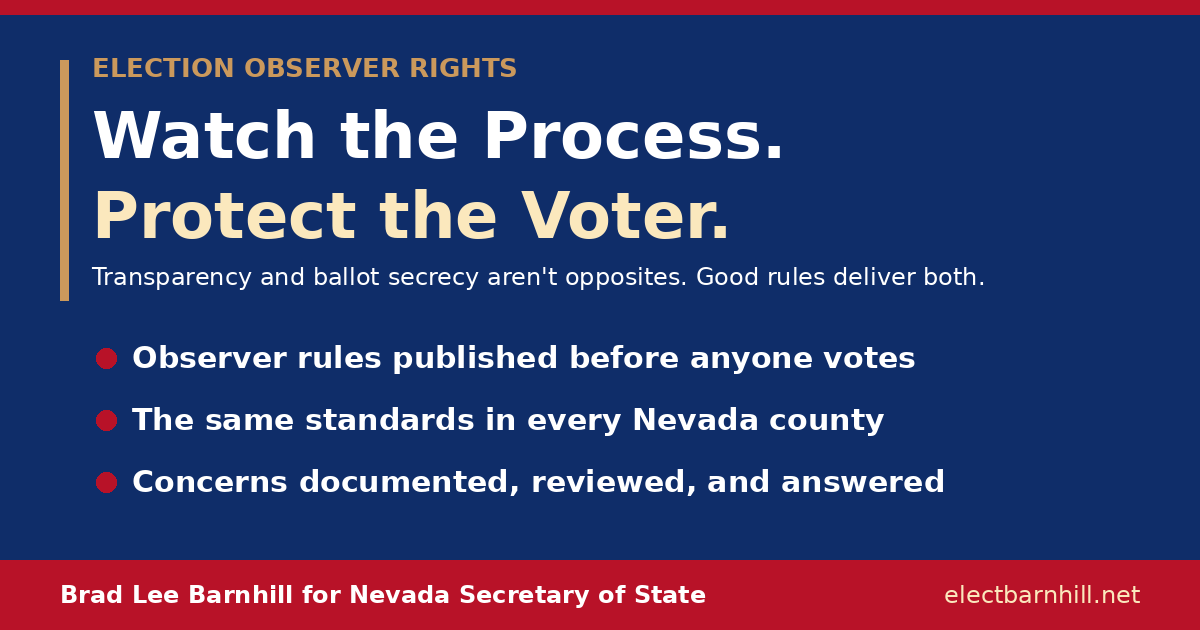
Clear observer rules should spell out where observers may stand, how questions may be raised, what equipment may be used, and how concerns get documented. Election workers should be trained on those rules before voting begins, not while a busy polling place is trying to serve voters.
A calm, orderly environment matters. Seniors, first-time voters, military families, workers on a short break, and voters with disabilities all deserve to cast a ballot without feeling watched or pressured. Protecting ballot secrecy isn’t a barrier to transparency. It’s one of the reasons transparency has to be structured carefully.
Election observer rights need clear statewide standards
Nevada voters shouldn’t need a law degree to understand how observation works. As Secretary of State, I’ll publish plain-language observer guidance before every election cycle, coordinate it with county election officials, and make the training materials easy to find, all under authority the office already has, without waiting on the Legislature.
That guidance should explain who may serve as an observer, how credentials or appointments work when they’re required, what activities may be observed, and how to report a concern. It should also make clear that election workers must treat observers fairly, regardless of party or viewpoint, as long as they follow the rules.
A statewide standard doesn’t require every county to use the same room layout or staffing plan. It sets the same expectations for access, conduct, documentation, and escalation. Counties then apply those expectations in ways that fit their facilities, with the same level of public accountability.
Public reporting makes it stronger. After each election, counties and the state should identify recurring observer questions, operational issues, and fixes for the next cycle, and include them in the quarterly public reports I’ve committed to. That isn’t about assigning blame. It’s about treating election administration as serious public work that gets better with experience.
What to do when you see a concern
An observer shouldn’t try to resolve every question on the spot. Some concerns have a simple explanation, like a procedure happening out of view to protect voter privacy. Others need a supervisor, a county election official, or a formal written report.
Record the basic facts: location, date, time, the activity you observed, and the names or roles of the people involved if you know them. Describe what happened without exaggeration, and don’t guess at motive. In 20 years as a systems analyst, the most useful problem report I ever got was the one that said exactly what happened, where, and when. Twenty years as a litigation paralegal taught me the same thing about evidence. A factual report gives election administrators something they can investigate and answer.
Raise urgent operational concerns with the designated election official at the site. If the issue can’t be resolved there, submit it through the county’s established process or the appropriate state channel. You should expect a professional response, a documented review when warranted, and an explanation of what was found.
That approach serves everyone. A legitimate concern deserves attention. A misunderstanding deserves a clear answer. Neither should be buried under political rhetoric.
My pledge to Nevada voters
Elections should be run so well that nobody has to argue about the results. That starts with practical standards, not grand promises. Nevada needs election systems that protect lawful voters, preserve paper records, strengthen cybersecurity, maintain accurate voter rolls, and let the public see that the rules are being followed.
For observer access, that means fair rules published early, consistent training, and clear boundaries that protect voters and workers. It means the same respectful treatment for Democrats, Republicans, nonpartisan voters, and independents. No party should decide whose questions count. The standard is the same for every citizen: follow the law, respect the process, and bring forward facts.
The Secretary of State can’t run every precinct or replace county election officials. But the office can lead with standards, guidance, public reporting, and accountable oversight. It can make transparency practical and confusion less profitable.
Confidence in elections is built one visible, documented, lawful step at a time. A voter who understands the rules is harder to mislead, and an observer who respects those rules helps every Nevadan see that their vote is treated with care. (Want to see your own part of the process? Check your registration and track your mail ballot.)
I’ve put my plans in writing and taken the fight for clean voter rolls to federal court. Is your candidate for Nevada Secretary of State fighting this hard to protect your vote? If not, it’s time to take a closer look.
Get to know me · Join the campaign · Donate · See all policy positions
I’m not asking you to trust a party on any of this. I’m asking you to hold the office accountable for solving real problems. That’s the job, and I intend to do it.
— Brad Lee Barnhill
Independent American Party of Nevada Candidate for Nevada Secretary of State
#YourIndependentVoice — Results, Not Noise
