


Not every update in Barnhill v. Aguilar is going to be about voter rolls. Today’s is about something much more mundane — and, honestly, a little absurd.
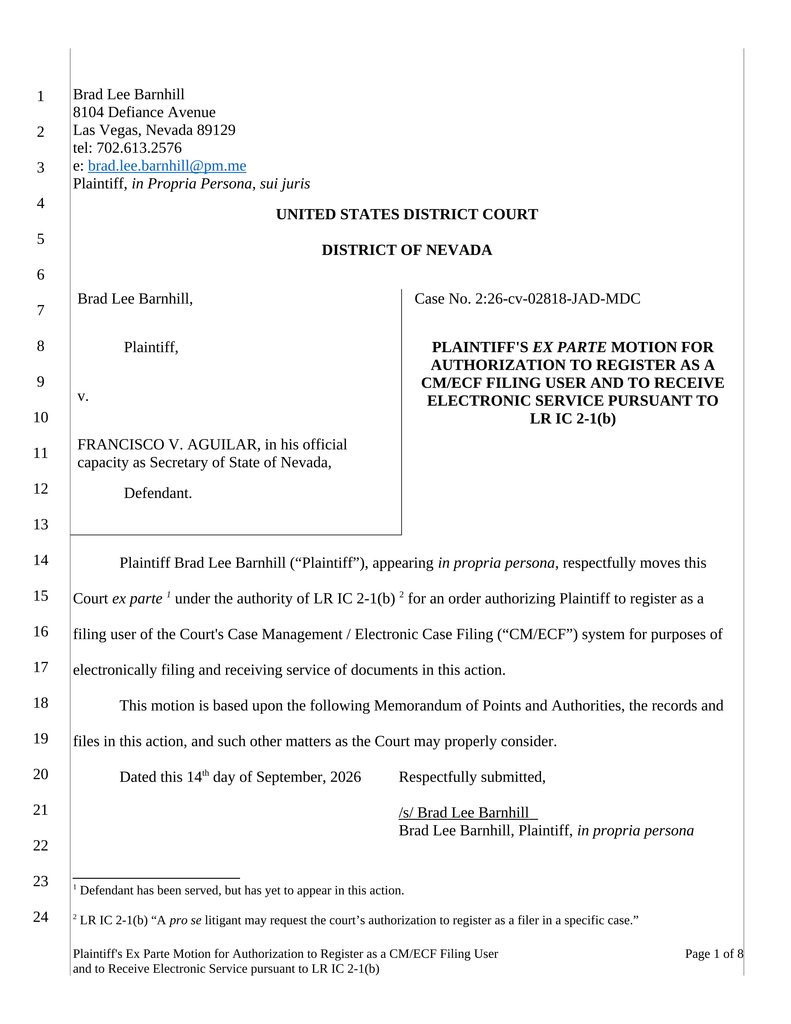
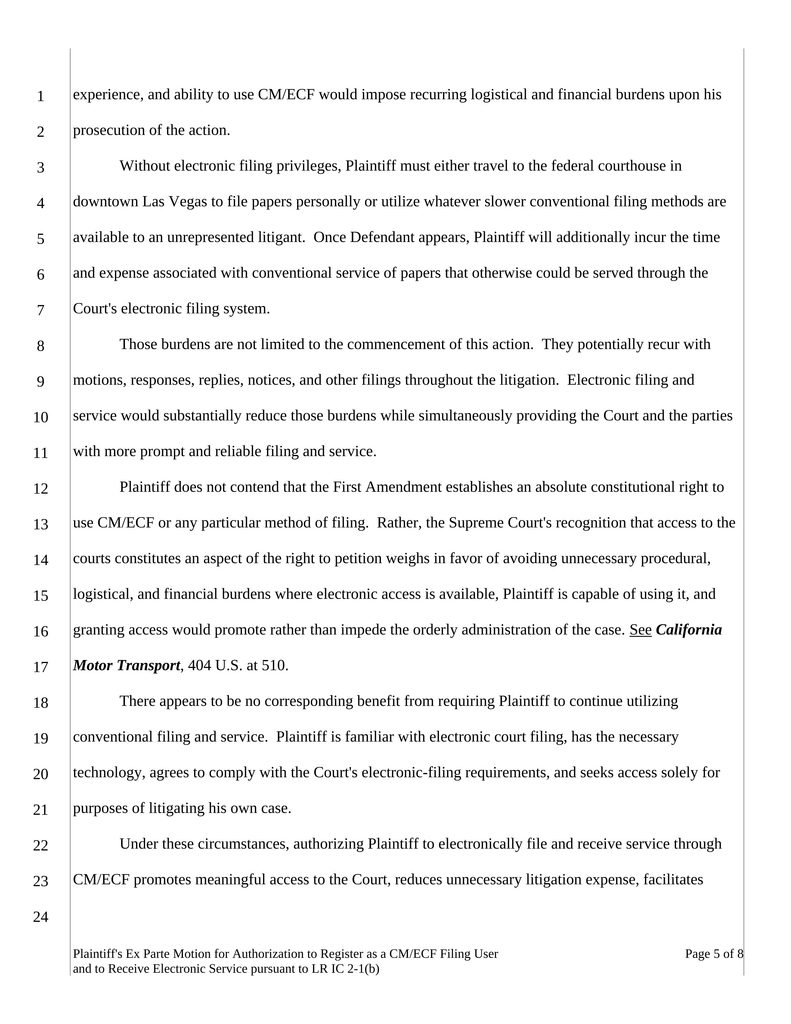
I filed a motion asking the federal court for permission to file my own paperwork electronically.
The problem
Federal courts run on an electronic filing system called CM/ECF. Attorneys use it every day. When you’re representing yourself, like I am in this case, you’re allowed to ask the court for permission to use it too — but the standard registration process only recognizes one kind of applicant: a licensed attorney.
I tried to register anyway. It got rejected. When I asked why, the court’s Attorney Registration office pointed me to the “Motion for Admission to Practice” — a form that requires you to certify you’re an active member in good standing of the State Bar of Nevada, and to have a sponsor who’s a member of the federal bar.
I’m not an attorney. I’ve never claimed to be one. I’m not asking to practice law or represent anyone but myself. So I couldn’t sign that form truthfully, and I wasn’t going to try.
The fix
Local Rule IC 2-1(b) exists for exactly this situation: a pro se litigant — someone representing themselves — can ask the court directly for permission to register as an electronic filer in their own case, without going through the attorney-admission process. So that’s what I filed: a narrow, limited request asking the court to let me file and receive documents electronically in this one case, nothing more.
I made a point of keeping the request small. I’m not asking for bar admission. I’m not asking to file on anyone else’s behalf. I’m asking for the same practical access to the court’s system that makes this case move faster and cost less — for me and for the court’s own docket.
Why this is worth mentioning at all
Because it’s a small example of the same thing I keep saying about the Secretary of State’s office: most of the friction people run into with government isn’t malice, it’s process built around an assumption that doesn’t fit everyone. The court’s registration system assumes every self-represented filer is either a licensed attorney or doesn’t need electronic access. Neither was true here, so the process didn’t work — until someone pointed at the actual rule that solves it.
That’s the same instinct I’d bring to this office. Twenty-plus years of drafting, filing, and tracking documents through court systems doesn’t stop being useful just because the case is my own.
One more thing worth being upfront about, since I ask for the same transparency from Nevada’s election system: this filing includes a required certification disclosing that AI assistance was used in preparing part of it, and that I personally reviewed it for accuracy before it went to the court. I don’t think that kind of disclosure should be unusual. It should be the default.
I’ll post an update once the court rules on the request.
— Brad Lee Barnhill
#YourIndependentVoice for Nevada Secretary of State
Barnhill v. Aguilar — Case Timeline
May 20, 2026 Barnhill submitted a sworn complaint concerning alleged duplicate voter-registration records to the Nevada Secretary of State’s Elections Division and Clark County officials. See Who Will Protect Your Vote?
June 3–4, 2026 Formal notice was sent under the National Voter Registration Act. The Secretary of State’s office closed its file on June 4 without, according to the complaint, disputing the underlying data analysis.
September 4, 2026 Barnhill filed Barnhill v. Aguilar, Case No. 2:26-cv-02818-JAD-MDC, in the U.S. District Court for the District of Nevada.
September 8, 2026 Secretary of State Francisco V. Aguilar and the Nevada Attorney General’s office were formally served with the lawsuit.
September 14, 2026 Barnhill filed an ex parte motion asking the Court to authorize him to register as a CM/ECF filing user and receive electronic service in this action under LR IC 2-1(b), since the standard registration process assumes an attorney applicant. See A Small Procedural Fight, With a Bigger Point Behind It.
What happens next The defendants may respond to the complaint through an answer or an early motion, including a motion to dismiss, and the Court will rule on the pending e-filing motion.
Latest update: A Small Procedural Fight, With a Bigger Point Behind It.
