


#YourIndependentVoice | Results, Not Noise
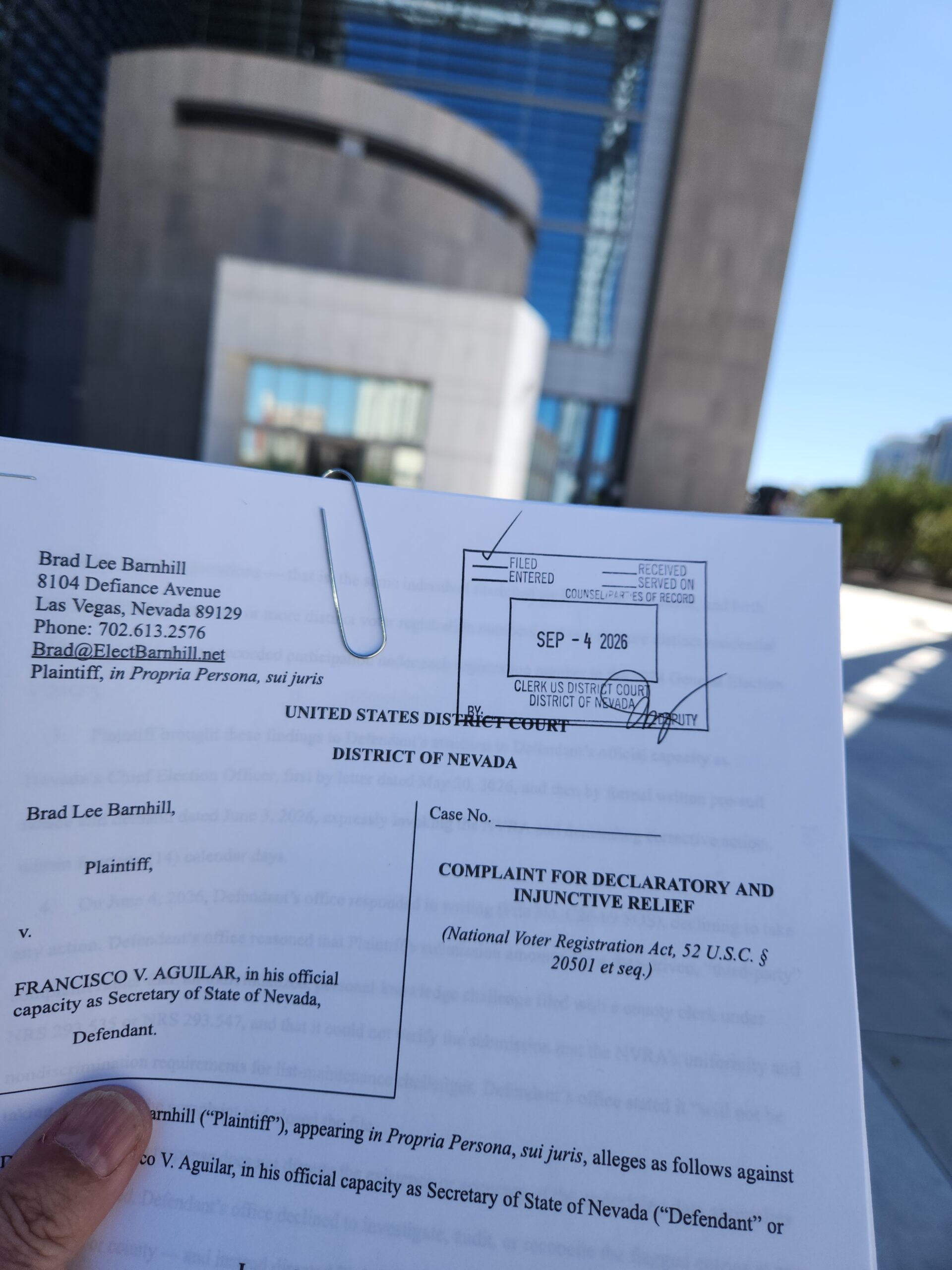
On Tuesday, September 8, 2026, Secretary of State Francisco Aguilar and the Nevada Attorney General’s office were formally served in Barnhill v. Aguilar (Case No. 2:26-cv-02818-JAD-MDC), the federal lawsuit I filed on September 4, 2026 under the National Voter Registration Act.
The Attorney General’s office is served alongside the Secretary because it represents state officials sued in their official capacity — that’s standard practice, not a sign of a second defendant.
Service is a procedural milestone, not the finish line, and Nevadans deserve to understand what happens from here.
This case did not begin with the filing on September 4. It began with the voter-roll analysis and the effort to obtain an administrative review that I documented earlier. Read the original voter-roll findings and how the dispute began.
I then filed the federal complaint on September 4. Read the filing announcement and the claims presented to the court.
What Usually Happens Next
In federal civil litigation, a defendant who has just been served typically has a limited window to respond. Rather than answering the complaint outright, government defendants very often file a motion to dismiss — asking the court to throw the case out before it ever reaches the evidence.
That’s not unusual, and it isn’t a sign the case lacks merit. It’s a standard early move. Motions to dismiss generally argue one or more of the following:
- Lack of standing — that the plaintiff isn’t the right party to bring the claim, or hasn’t suffered a concrete injury
- Failure to state a claim — that even if every fact alleged is true, it doesn’t add up to a legal violation
- Mootness or ripeness — that the issue isn’t ready for a court, or has already been resolved
- Jurisdictional or immunity defenses — arguments that the court lacks authority to hear the case, or that the official defendant is shielded from suit
Any of these can be raised. None of them require the defendant to dispute the underlying data.
Why This Case Was Built to Withstand That Test
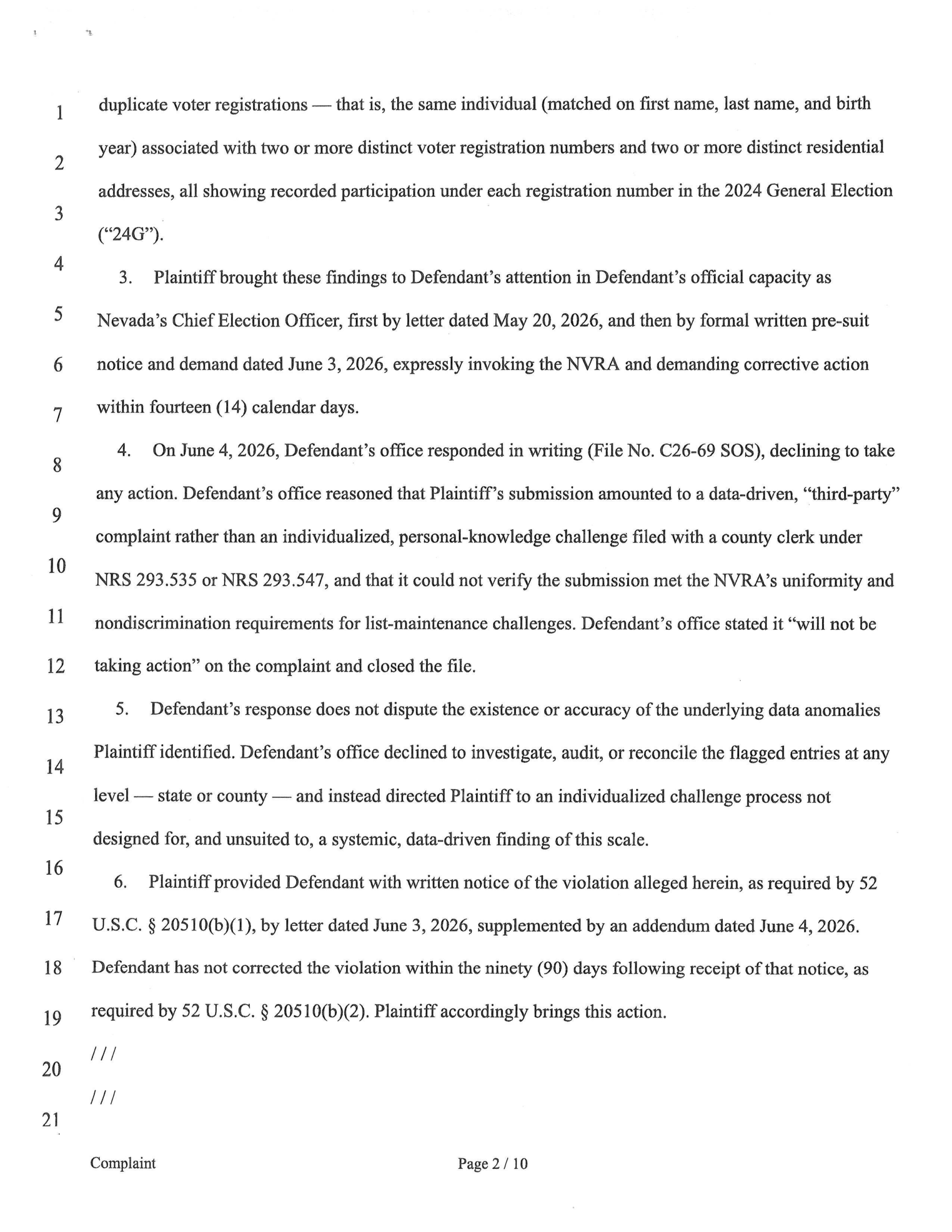
This lawsuit isn’t a hunch — it’s built on a specific, documented data set, and on a paper trail the Secretary of State’s office has already seen and did not dispute:
- Approximately 9,607 individuals in Clark County matched by name and birth year across multiple active voter registration numbers
- Producing approximately 12,465 matched registration pairs
- With both registrations in each pair reflecting a recorded vote in the 2024 General Election
- Formal notice was sent to Secretary Aguilar by letter on June 3–4, 2026 (File No. C26-69 SOS). His office closed that complaint on June 4 without disputing the underlying data — it instead pointed to an individualized county-level challenge process not designed for a systemic, data-driven finding of this scale.
That last point matters. A motion to dismiss is not the same as a denial of the facts. If the Secretary of State’s office already reviewed this data months ago and closed the file without challenging its accuracy, a procedural motion now would be about whether the court can act — not about whether the problem exists.
What I Expect — and Why
I expect the Secretary’s office to file a motion to dismiss. That’s their right, and I take it seriously. But I believe it should fail, for a simple reason: the NVRA imposes specific list-maintenance obligations on state election officials, and this complaint documents, with real numbers, a pattern the Secretary’s own office was notified of and never rebutted. A procedural motion doesn’t make matched voter pairs disappear. It doesn’t explain how 12,465 registration pairs — both sides recording a 2024 vote — came to exist. It only asks a judge to decide whether the case gets to move forward.
I’m confident it should. Nevadans are entitled to know their voter rolls are accurate, and to have that question resolved on the merits — not waved off on a technicality.
What This Is Not
To be direct, because this gets distorted quickly: this lawsuit does not seek automatic disenrollment of any voter. It seeks a flag-and-investigate process — cross-checking against sources like SSA records, citizenship verification, and property records so that questionable matches get looked at by a human being before any registration is touched. That distinction matters, and it will matter in front of the court too.
What Happens Next
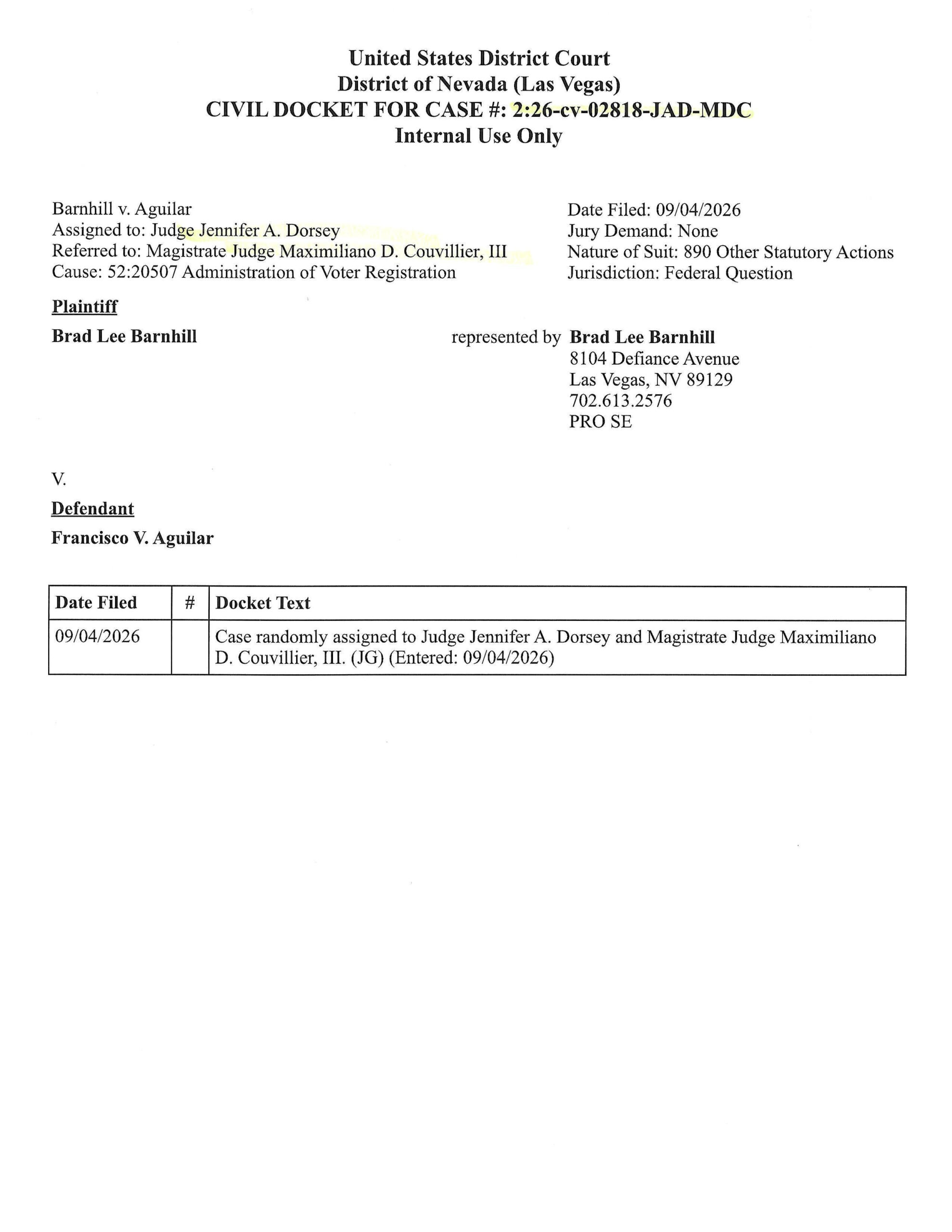
The case has been randomly assigned to U.S. District Judge Jennifer A. Dorsey, with Magistrate Judge Maximiliano D. Couvillier, III handling pretrial matters.
- If a motion to dismiss is filed, we’ll respond on the record and keep you updated here.
- If the case proceeds past that stage, it moves toward the fact-finding the Secretary’s office avoided back in June.
Either way, this is what accountability looks like: not noise, not accusations — a documented question, asked in the right forum, that Nevada voters deserve an answer to.
The same administrative-authority argument at the heart of this case applies to Question 7 implementation as well — see Voter ID Is Coming: Let’s Talk About Making It Actually Work for People.
For the complete chronology—from the original voter-roll analysis, through the administrative complaint, to the federal filing and service—see the earlier voter-roll investigation report and federal filing announcement.
Who will protect your vote?
I will.
— Brad Lee Barnhill
Candidate for Nevada Secretary of State
electbarnhill.net | 702-613-2576
Barnhill v. Aguilar — Case Timeline
May 20, 2026 Barnhill submitted a sworn complaint concerning alleged duplicate voter-registration records to the Nevada Secretary of State’s Elections Division and Clark County officials. See Who Will Protect Your Vote?
June 3–4, 2026 Formal notice was sent under the National Voter Registration Act. The Secretary of State’s office closed its file on June 4 without, according to the complaint, disputing the underlying data analysis.
September 4, 2026 Barnhill filed Barnhill v. Aguilar, Case No. 2:26-cv-02818-JAD-MDC, in the U.S. District Court for the District of Nevada.
September 8, 2026 Secretary of State Francisco V. Aguilar and the Nevada Attorney General’s office were formally served with the lawsuit.
September 14, 2026 Barnhill filed an ex parte motion asking the Court to authorize him to register as a CM/ECF filing user and receive electronic service in this action under LR IC 2-1(b), since the standard registration process assumes an attorney applicant. See A Small Procedural Fight, With a Bigger Point Behind It.
What happens next The defendants may respond to the complaint through an answer or an early motion, including a motion to dismiss, and the Court will rule on the pending e-filing motion.
Latest update: A Small Procedural Fight, With a Bigger Point Behind It.
2 thoughts on “Service Is Complete. Here’s What Comes Next in Barnhill v. Aguilar.”