


On September 4, I filed Barnhill v. Aguilar (Case No. 2:26-cv-02818-JAD-MDC) in federal court. The case asks a simple question. Why did 9,607 Nevadans have duplicate active voter registrations, with a 2024 General Election vote recorded under both registration numbers?
I’m not alleging fraud. I’m asking for an audit, a reconciliation, a public report, and a statewide system to catch duplicates before they happen again.
What happened
Secretary Aguilar did not answer the complaint. On September 28, his office asked the court to put my case on hold and to give him more time to respond. I wrote an opposition to both requests (ECF No. 9). I also wrote a motion to consolidate my case with the related RNC v. Aguilar matter (ECF No. 10), so the questions about Nevada’s voter rolls can move forward together instead of sitting on a shelf.
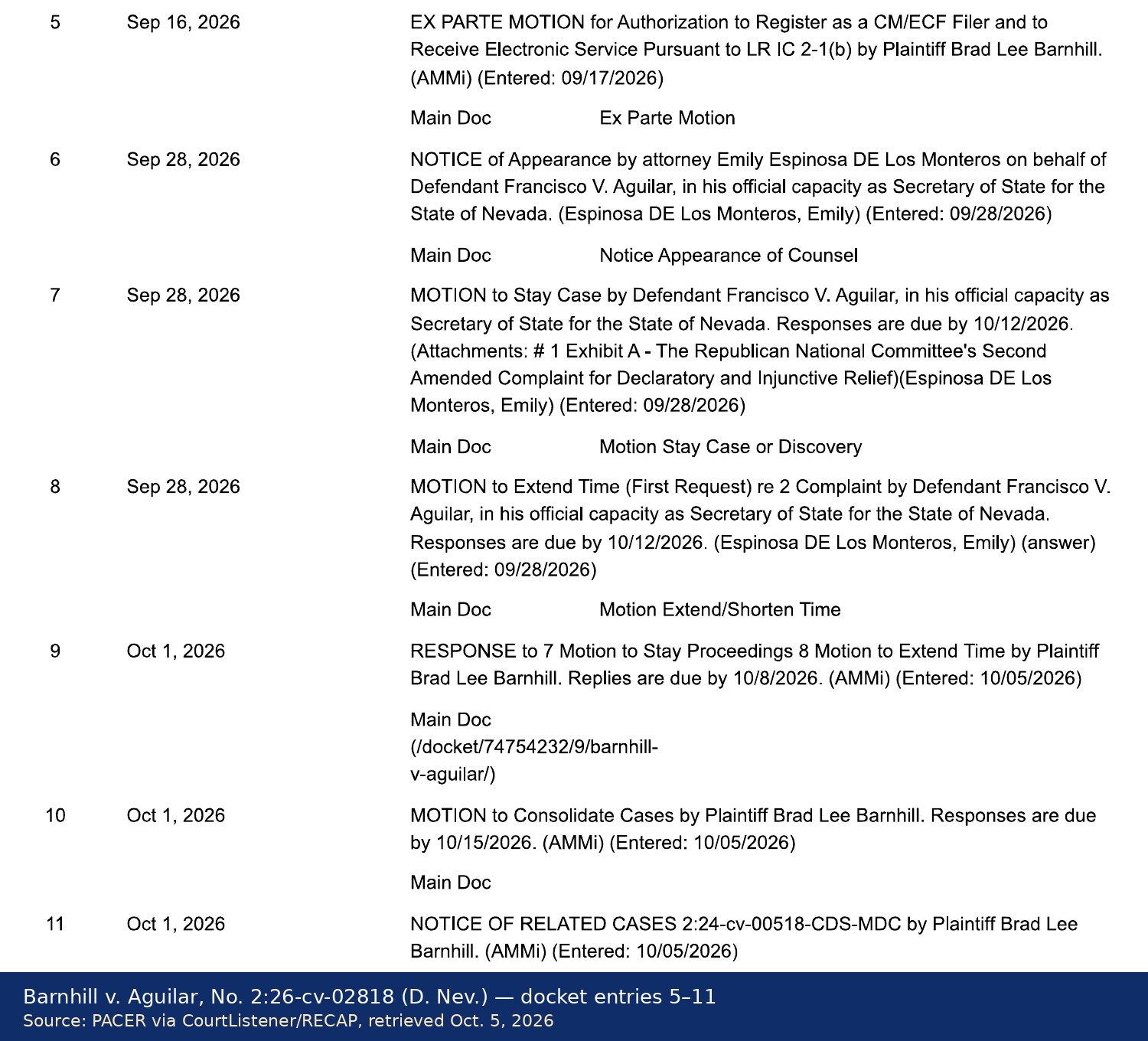
I finished those documents on September 29 and signed and mailed them the next day. An attorney could have filed them the evening they were finished and had them on the docket within minutes. The clerk marked them filed on October 1, but they didn’t show up on the docket until October 5.
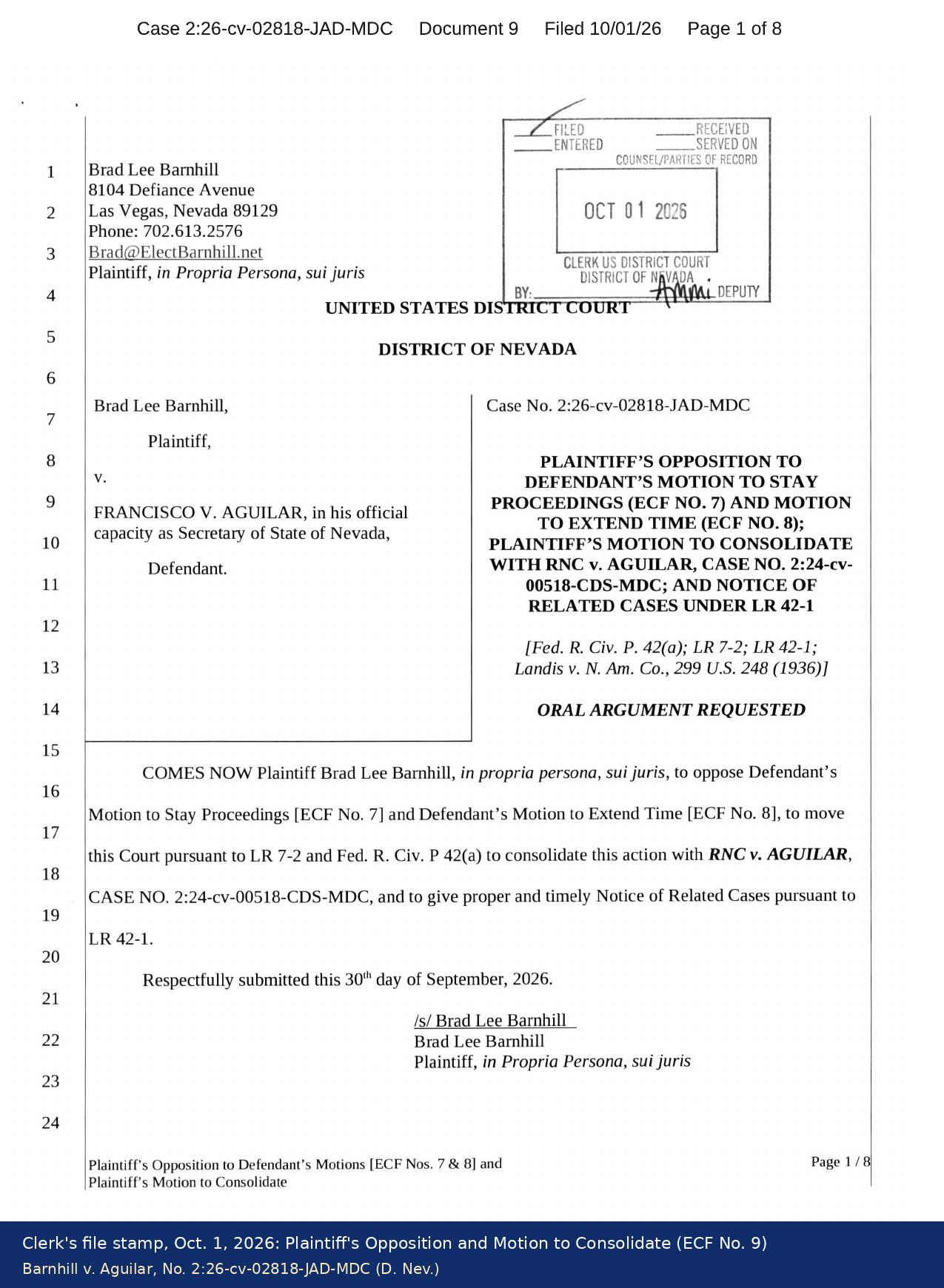
That’s six days from finished work to public record. A lawyer’s version of the same filing takes six minutes.
Why I have to use the mail
Attorneys file electronically. Their documents reach the court and the other side almost instantly. As a self-represented citizen, I can’t use that system unless the court gives me permission.
On September 16, I filed an ex parte motion asking for that permission (ECF No. 5). It’s a routine request under the court’s own local rules. Almost three weeks later, the court has not ruled on it.
The delay works in both directions
Without electronic access, I don’t just send my filings by mail. I also receive everything by mail.
When the Secretary of State’s lawyers file something, they’re notified instantly. I wait for an envelope. The federal rules recognize this problem. Rule 6(d) adds three days to my deadlines when I’m served by mail, and I’m grateful for that.
But three extra days only help if I’m home to open the mailbox. I’m running a statewide campaign. When I’m on the road talking to voters, a filing can sit in my mailbox while my response deadline keeps running. Electronic access would put that notice in my inbox the moment it’s filed, wherever I am.
Why this matters
This isn’t a complaint about busy judges or clerks. I respect the court and its workload. But the delay has real effects:
- The playing field isn’t level. The Secretary of State’s lawyers file and receive notice instantly. I send and receive by mail.
- Deadlines don’t wait. My deadlines keep running whether I’m home or not, and my filings aren’t on the docket until the clerk enters them.
- The clock is running toward November. Every week this case stalls is a week closer to the next election with the duplicate registration question unanswered.
I’m not asking for special treatment. I’m asking for the same tools the other side already has.
What this says about government
I spent 20 years as a computer systems analyst and 20 years as a litigation paralegal. I solve problems for a living. When a digital system depends on paper and postage to work for ordinary citizens, that is a design problem. It can be fixed.
The Secretary of State’s office runs systems that citizens depend on every day, from voter registration to business filings. As your Secretary of State, I’ll make sure those systems work for the person without a law firm behind them, not just for the people who have one.
I’ll keep pressing forward, by mail if I have to.
Results, Not Noise.
#YourIndependentVoice
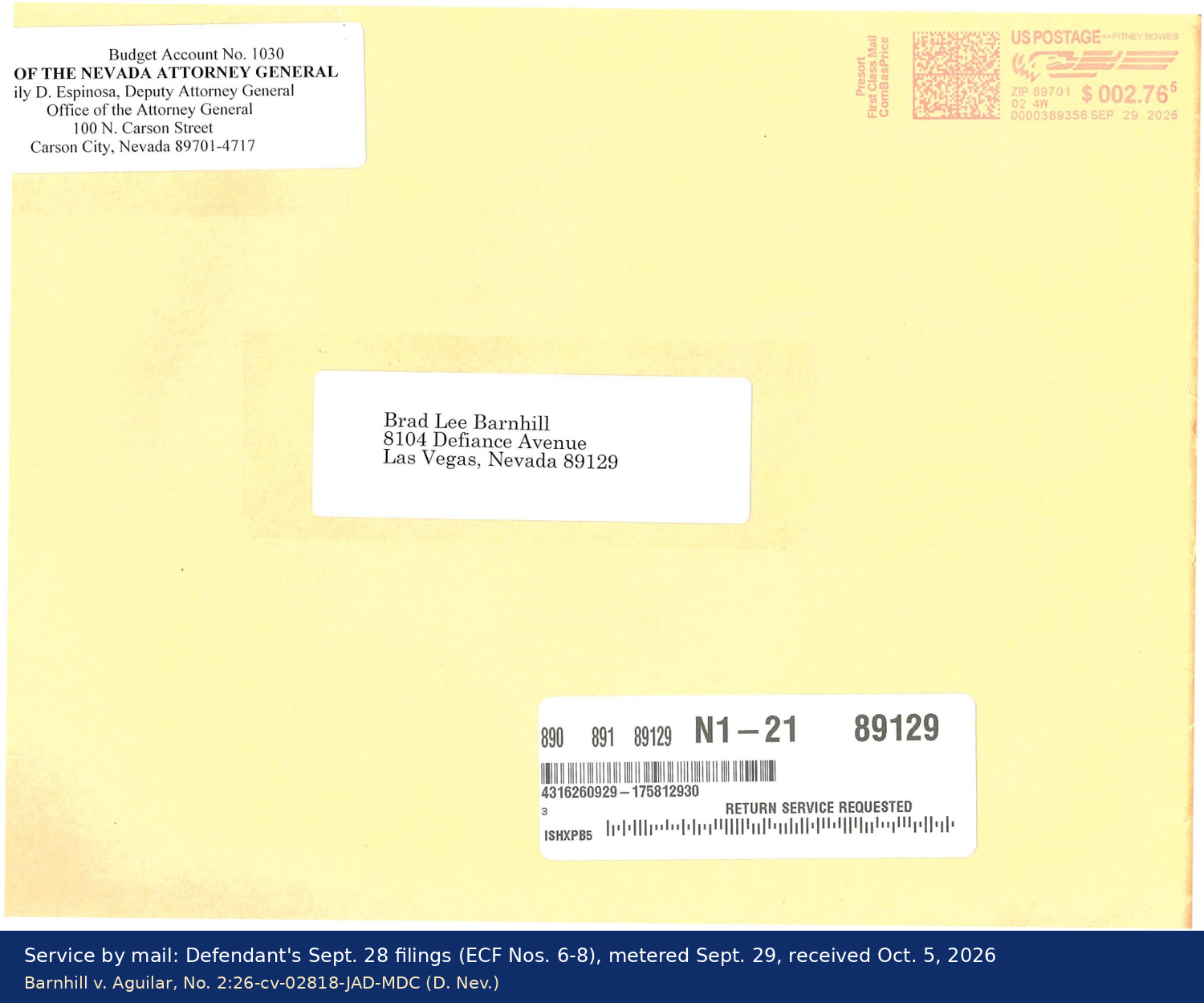
P.S. Today’s mail brought the Secretary of State’s motions to stay and to extend time, along with his attorney’s notice of appearance. They were filed electronically on September 28 and metered for mailing on September 29. They arrived on October 5. By then I had already read them on the public docket, written my opposition, and mailed it to the court, which stamped it filed on October 1. I keep a close eye on the docket. A citizen who doesn’t would have lost a week of a two-week deadline before the envelope ever arrived.
Get to know me · Join the campaign · Donate
Barnhill v. Aguilar — Case Timeline
May 20, 2026 Barnhill submitted a sworn complaint concerning alleged duplicate voter-registration records to the Nevada Secretary of State’s Elections Division and Clark County officials. See Who Will Protect Your Vote?
June 3–4, 2026 Formal notice was sent under the National Voter Registration Act. The Secretary of State’s office closed its file on June 4 without, according to the complaint, disputing the underlying data analysis.
September 4, 2026 Barnhill filed Barnhill v. Aguilar, Case No. 2:26-cv-02818-JAD-MDC, in the U.S. District Court for the District of Nevada.
September 8, 2026 Secretary of State Francisco V. Aguilar and the Nevada Attorney General’s office were formally served with the lawsuit.
September 16, 2026 Barnhill filed an ex parte motion asking the Court to authorize him to register as a CM/ECF filing user and receive electronic service in this action under LR IC 2-1(b), since the standard registration process assumes an attorney applicant. See A Small Procedural Fight, With a Bigger Point Behind It.
September 28, 2026 Aguilar moves the Court to suspend my action indefinitely while another action Aguilar is defending against the Republican National Committee has completed. No way, Jose! I oppose the motion and request consolidation with the RNC action. See While the Secretary of State Asks for More Time, I’m Asking the Court to Move Faster.
October 1, 2026 Barnhill’s Opposition to the motions to stay and extend time (ECF No. 9), Motion to Consolidate (ECF No. 10), and Notice of Related Cases (ECF No. 11) were filed by mail. They were not entered on the docket until October 5. The Court has not yet ruled on the September 16 e-filing motion. See Equal Access to the Courthouse Shouldn’t Depend on Having a Lawyer.
October 6, 2026 Barnhill mailed a Notice of Lodging Proposed Order and Request for Ruling on the September 16 e-filing motion, with a proposed order attached.
Latest update: I’ve Asked the Court to Rule on My E-Filing Request.
1 thought on “Equal Access to the Courthouse Shouldn’t Depend on Having a Lawyer”