

Before early voting began, the Nevada Appeal asked every candidate for Secretary of State the same questions. Two of us answered: Secretary Cisco Aguilar and me. If you’re deciding how to vote, I’d encourage you to read both answers side by side. They show two different ideas of what this office is for.
I wrote my answers before I filed my federal lawsuit over Nevada’s voter rolls, so you won’t find it there. I’ll fill in that part here.
Credit where it’s due
Secretary Aguilar replaced an outdated business filing system, moved the state onto a new voter registration system, and points to a national ranking that placed Nevada’s elections second in the country. He also reports a big rise in tribal turnout in 2024. Those are real efforts, and voters should weigh them.
Where we agree: Nevada’s voter data belongs to Nevadans
When the U.S. Department of Justice demanded Nevada’s complete, unredacted voter file, including birth dates, driver’s license numbers, and partial Social Security numbers, Secretary Aguilar gave federal officials the public voter list and declined to hand over the rest, citing Nevada privacy law. A federal judge has since dismissed the DOJ’s lawsuit.
He was right, and I’d have done the same. Nevadans gave that information to their state so they could vote, not so it could be handed to federal agencies. Nevada’s voter registration information belongs to Nevadans.
That’s also why I keep pushing on the voter rolls. Keeping Nevada’s data in Nevada’s hands only works if Nevada does its own list maintenance, and does it well. If we want Washington to stay out, the state has to keep its own house in order.
Here’s where we differ.
New software isn’t the same as a working system
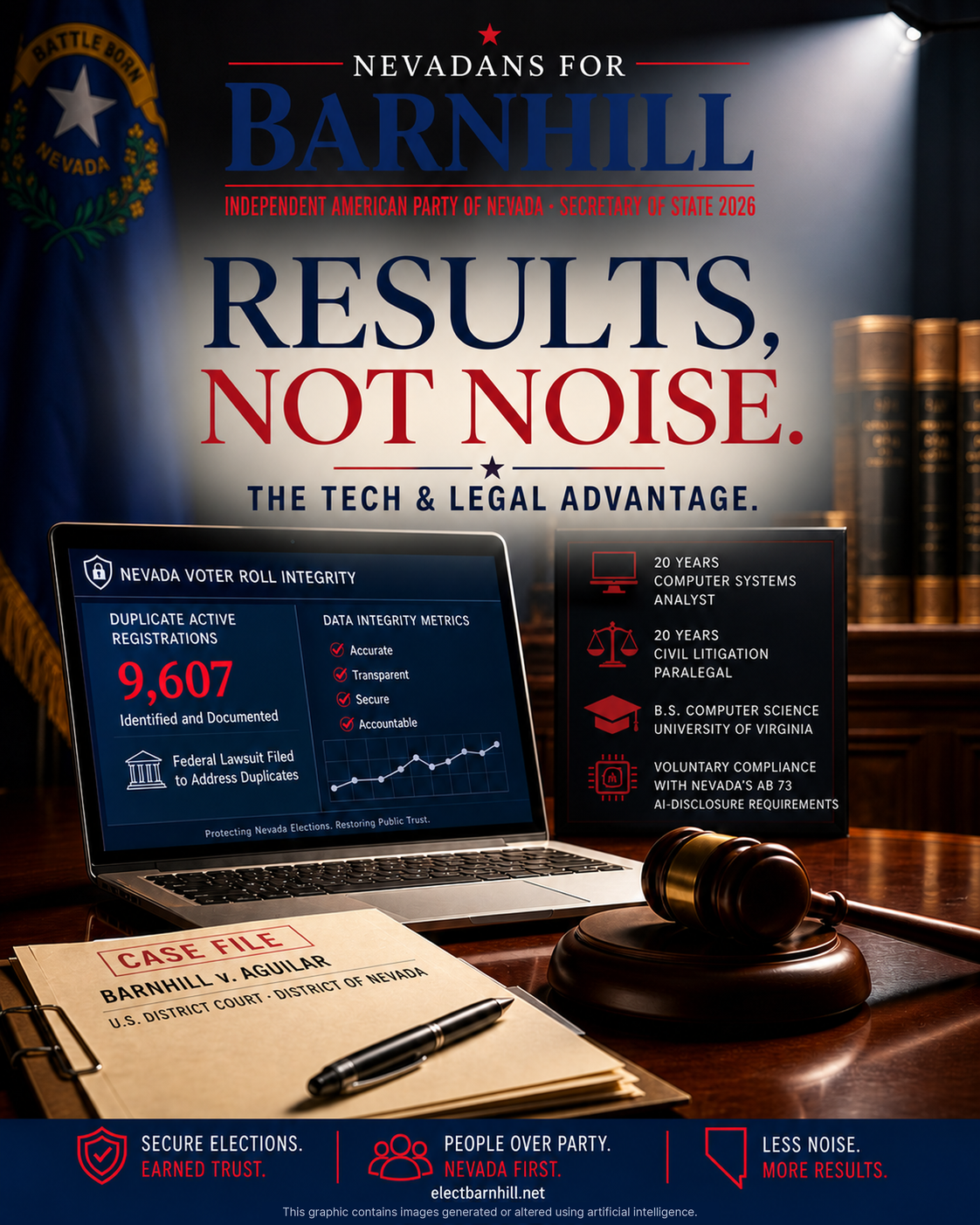
Much of the Secretary’s record is new technology. Technology matters, but I spent more than 20 years as a computer systems analyst, and the lesson I wrote in my answer is the one I’d bring on day one: if a process is poorly designed, automating it just produces an automated mess.
A new platform is a starting point. The question voters should ask is whether the data inside it is accurate, and whether they can check it for themselves.
The voter rolls are missing from his answer
Secretary Aguilar’s answer doesn’t mention voter-roll maintenance, Voter ID, or Question 7, which is on your ballot right now. Mine addresses all three, because that’s where public confidence is won or lost.
When I found 9,607 Nevadans with duplicate active voter registrations, I reported them to the Secretary of State’s office. The office closed my complaint without disputing the data. I’m not alleging fraud. I’m asking for an audit and a fix.
Transparency you can check
The Secretary lists transparency as a core value. So do I. The difference shows when a citizen tests it.
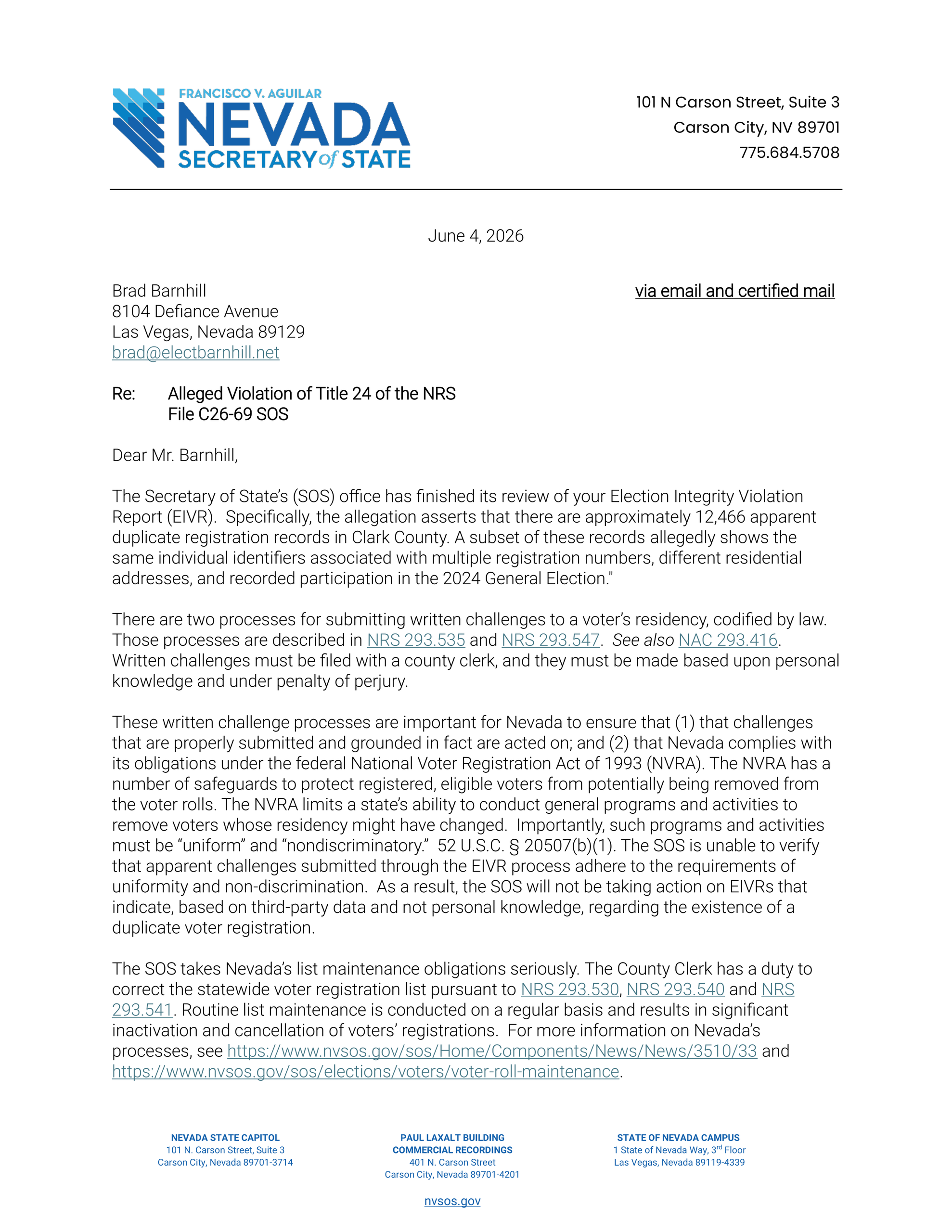
I didn’t get an explanation. I got a closed file. So I filed Barnhill v. Aguilar in federal court. Since then, the office has asked the court to put my case on hold behind a lawsuit brought by a national party committee. I publish every filing and development on this site as it happens, so you can judge for yourself.
A bigger office needs bigger checks
For a second term, Secretary Aguilar proposes creating a bank inside the office to process business card payments, and he’s seeking power to prosecute fraud directly. Lower fees for small businesses and fewer fraud victims are worthy goals.
But both proposals expand the authority of the same office that runs our elections. Before Nevada adds a bank and prosecutors to it, voters deserve answers:
- Who audits the bank, and who is liable if something goes wrong?
- Who oversees decisions about whom to prosecute?
- What will it cost, and how does it fit with the Attorney General and county district attorneys, who already prosecute fraud?
Those are fair questions for any candidate who wants more power, and I’d expect voters to ask them of me.
The short version
Secretary Aguilar wrote that Nevadans shouldn’t need a law degree to start a business. I agree.
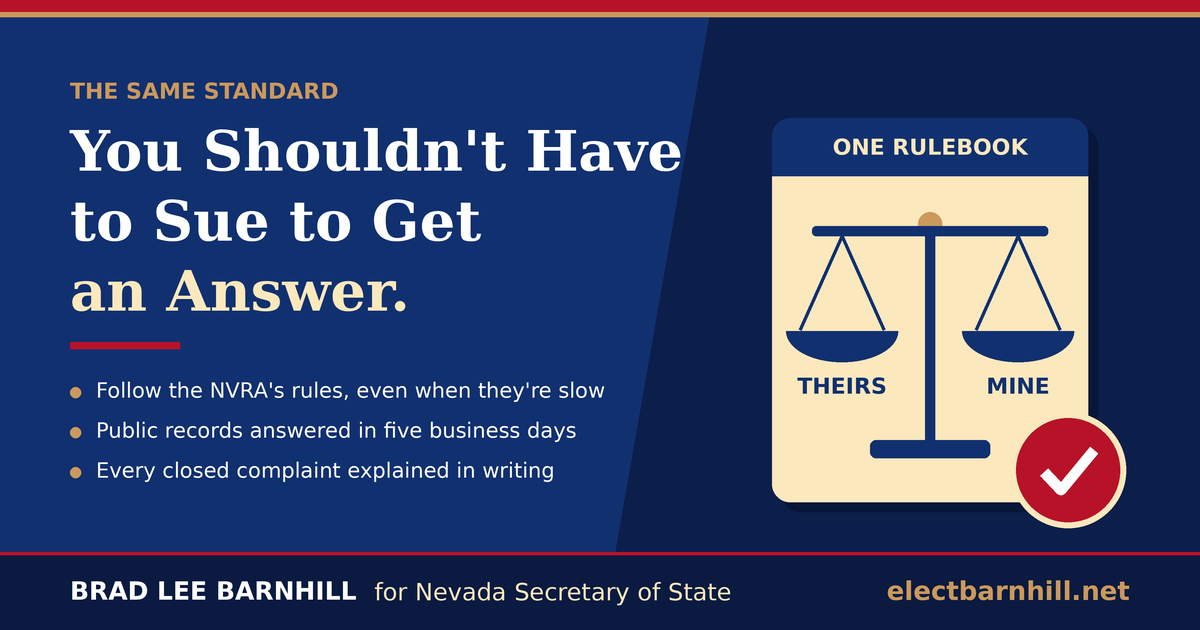
They also shouldn’t need a federal lawsuit to get an answer from their Secretary of State. I’ve written down the standard I’d hold my own office to, before a single vote is cast. Read both of our answers, then decide who’s showing you the work.
Barnhill v. Aguilar — Case Timeline
May 20, 2026 Barnhill submitted a sworn complaint concerning alleged duplicate voter-registration records to the Nevada Secretary of State’s Elections Division and Clark County officials. See Who Will Protect Your Vote?
June 3–4, 2026 Formal notice was sent under the National Voter Registration Act. The Secretary of State’s office closed its file on June 4 without, according to the complaint, disputing the underlying data analysis.
September 4, 2026 Barnhill filed Barnhill v. Aguilar, Case No. 2:26-cv-02818-JAD-MDC, in the U.S. District Court for the District of Nevada.
September 8, 2026 Secretary of State Francisco V. Aguilar and the Nevada Attorney General’s office were formally served with the lawsuit.
September 16, 2026 Barnhill filed an ex parte motion asking the Court to authorize him to register as a CM/ECF filing user and receive electronic service in this action under LR IC 2-1(b), since the standard registration process assumes an attorney applicant. See A Small Procedural Fight, With a Bigger Point Behind It.
September 28, 2026 Secretary of State Aguilar moved the Court to stay Barnhill’s case indefinitely until a separate lawsuit brought by the Republican National Committee is resolved. Barnhill opposed the stay and asked the Court to consolidate or coordinate the two cases instead. See While the Secretary of State Asks for More Time, I’m Asking the Court to Move Faster.
September 28, 2026 Barnhill’s Certificate of Interested Parties, dated September 28, certified that the only parties to the case are Barnhill, a Nevada voter, and the Secretary of State, with no corporate backers, affiliates, or insurer. See The Court Asked Who Has a Stake in My Lawsuit. The Honest Answer Is You.
October 1, 2026 Barnhill’s Opposition to the motions to stay and extend time (ECF No. 9), Motion to Consolidate (ECF No. 10), and Notice of Related Cases (ECF No. 11) were filed by mail. They were not entered on the docket until October 5. The Court has not yet ruled on the September 16 e-filing motion. See Equal Access to the Courthouse Shouldn’t Depend on Having a Lawyer.
October 6, 2026 Barnhill mailed a Notice of Lodging Proposed Order and Request for Ruling on the September 16 e-filing motion, with a proposed order attached. See I’ve Asked the Court to Rule on My E-Filing Request.
Latest update: The Court Asked Who Has a Stake in My Lawsuit. The Honest Answer Is You.
I took the Secretary of State to federal court to protect your vote. Has your candidate?
