


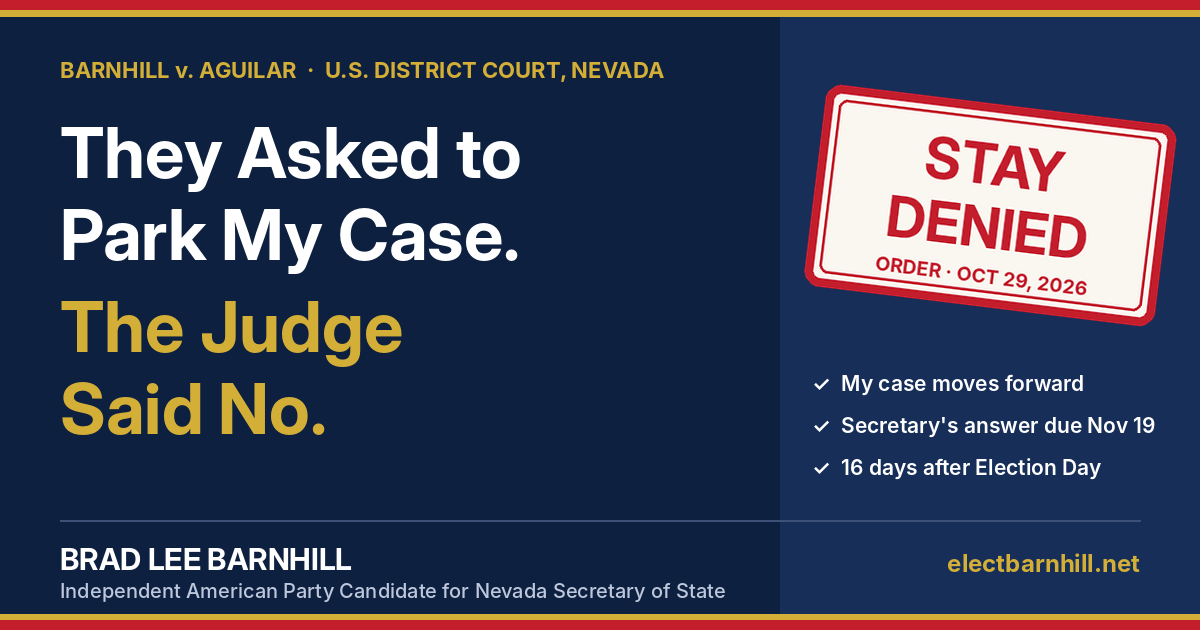
On October 29, U.S. District Judge Jennifer Dorsey denied Secretary of State Cisco Aguilar’s request to put Barnhill v. Aguilar on hold. My case moves forward on its own track, and the Secretary now has until November 19 to answer my complaint.
The Secretary’s office wanted my case treated as a footnote to someone else’s lawsuit. The court said it isn’t.
What the Secretary wanted
He asked the court to freeze my case until a separate lawsuit, brought by the Republican National Committee in 2024, is resolved. His argument: both cases involve the same section of the National Voter Registration Act, so letting both proceed could produce conflicting rulings.
Think about what “on hold” means. The RNC’s case has been in court since 2024. Mine would have waited behind it, with no end date, while 9,607 duplicate active registrations stayed unexplained.
What the judge decided
The judge found the two cases are different. The RNC challenges the Secretary’s statewide list-maintenance program. Mine asks what she called a much narrower question: whether the office broke federal law when it refused to look into the duplicates I found because my complaint wasn’t based on “individualized, personal knowledge.”
She found no hardship to the Secretary in moving forward, no real risk of conflicting rulings, and no reason to think a stay would simplify anything. My case is now on the standard litigation track.
His argument, turned around
The Secretary’s whole case for a stay rested on one claim: my lawsuit and the RNC’s are really the same lawsuit. I said they aren’t.
On October 19, I told the court I was withdrawing my request to consolidate the two cases, because they present distinct facts and issues. I asked for one narrower thing: that the two judges coordinate on the legal questions the cases share, while each case keeps its own docket, its own record, and its own ruling. No merger. No transfer. No stay.
The judge reached the same conclusion: the cases are distinct, so mine won’t be shelved and won’t be merged. She formally denied the consolidation motion as I first filed it. The order doesn’t address my narrower request to coordinate.
He didn’t even answer. Twice.
The Secretary never filed an opposition to my motion to consolidate. He never filed one to my request to file electronically, either, even after the court set an October 23 deadline for responses. Under the court’s own local rules, failing to oppose a motion counts as consent to granting it.
His office found time to ask for a stay. It found time to ask for an extension. It didn’t find time to answer either of a citizen’s motions.
Eight days in the mail
I mailed two notices to the court on October 19. The court docketed both on October 27: eight days later, and two days before the judge ruled.
A lawyer with e-filing access files in minutes. The Attorney General’s office files in minutes. A citizen without a law firm drops an envelope in the mail and waits.
That’s exactly why I asked the court for permission to file electronically (more on that request). The request is unopposed. The deadline to oppose it passed on October 23. The proposed order is already in the court’s hands. All that’s left is a signature, and until it comes, I’m still filing by mail.
This week proved the point. Equal access to the courthouse shouldn’t depend on having a lawyer.
“Individualized, personal knowledge”
That phrase is the heart of this case. I found 9,607 apparent duplicate registrations in Clark County’s voter records. The office didn’t say the data was wrong. It closed my complaint because I don’t personally know the people on the list.
Nobody personally knows 9,607 voters. If that’s the standard, no citizen can ever ask the state to check its own work. I’m not alleging fraud. I’m asking for an audit and a fix.
You’ll vote before he answers
The court also gave the Secretary more time. His response is due November 19, sixteen days after Election Day. Nevadans will choose their next Secretary of State before the current one tells a federal court why he wouldn’t check 9,607 records.
You don’t have to wait until November 19 to know where I stand. I’ve put the standard I’d hold my own office to in writing.
The short version
- The Secretary’s request to put my case on hold: denied. It moves forward.
- Consolidation, which I’d already withdrawn: denied. My case stands on its own, as I argued.
- My request to e-file: unopposed. The deadline passed October 23. Still no ruling.
- The Secretary’s answers to my two motions: never filed.
- My notices: mailed October 19, docketed October 27.
- The Secretary’s answer to my complaint: due November 19, after you vote.
Read the judge’s order (ECF No. 17) and my October 19 notice yourself. I publish every filing, win or lose.
Barnhill v. Aguilar — Case Timeline
May 20, 2026 Barnhill submitted a sworn complaint concerning alleged duplicate voter-registration records to the Nevada Secretary of State’s Elections Division and Clark County officials. See Who Will Protect Your Vote?
June 3–4, 2026 Formal notice was sent under the National Voter Registration Act. The Secretary of State’s office closed its file on June 4 without, according to the complaint, disputing the underlying data analysis.
September 4, 2026 Barnhill filed Barnhill v. Aguilar, Case No. 2:26-cv-02818-JAD-MDC, in the U.S. District Court for the District of Nevada.
September 8, 2026 Secretary of State Francisco V. Aguilar and the Nevada Attorney General’s office were formally served with the lawsuit.
September 16, 2026 Barnhill filed an ex parte motion asking the Court to authorize him to register as a CM/ECF filing user and receive electronic service in this action under LR IC 2-1(b), since the standard registration process assumes an attorney applicant. See A Small Procedural Fight, With a Bigger Point Behind It.
September 28, 2026 Secretary of State Aguilar moved the Court to stay Barnhill’s case indefinitely until a separate lawsuit brought by the Republican National Committee is resolved. Barnhill opposed the stay and asked the Court to consolidate or coordinate the two cases instead. See While the Secretary of State Asks for More Time, I’m Asking the Court to Move Faster.
September 28, 2026 Barnhill’s Certificate of Interested Parties, dated September 28, certified that the only parties to the case are Barnhill, a Nevada voter, and the Secretary of State, with no corporate backers, affiliates, or insurer. See The Court Asked Who Has a Stake in My Lawsuit. The Honest Answer Is You.
October 1, 2026 Barnhill’s Opposition to the motions to stay and extend time (ECF No. 9), Motion to Consolidate (ECF No. 10), and Notice of Related Cases (ECF No. 11) were filed by mail. They were not entered on the docket until October 5. The Court has not yet ruled on the September 16 e-filing motion. See Equal Access to the Courthouse Shouldn’t Depend on Having a Lawyer.
October 6, 2026 Barnhill mailed a Notice of Lodging Proposed Order and Request for Ruling on the September 16 e-filing motion, with a proposed order attached. See I’ve Asked the Court to Rule on My E-Filing Request.
October 16, 2026 The Court denied the October 6 request for ruling as moot and set October 23 as the deadline for responses to Barnhill’s e-filing motion (ECF No. 14).
October 23, 2026 The response deadline on Barnhill’s e-filing motion passed with no opposition from the Secretary of State.
October 27, 2026 Two notices Barnhill mailed on October 19 were docketed (ECF Nos. 15 and 16). One notified the Court that the Secretary had not opposed the motion to consolidate, withdrew the consolidation request, and asked only for coordination of pretrial proceedings. See the notice.
October 29, 2026 Judge Jennifer A. Dorsey denied the Secretary’s motion to stay, denied the motion to consolidate, and gave the Secretary until November 19 to answer the complaint (ECF No. 17). See The Secretary of State Asked the Court to Park My Case. The Judge Said No.
Latest update: The Secretary of State Asked the Court to Park My Case. The Judge Said No.
I took the Secretary of State to federal court to protect your vote. Has your candidate?
